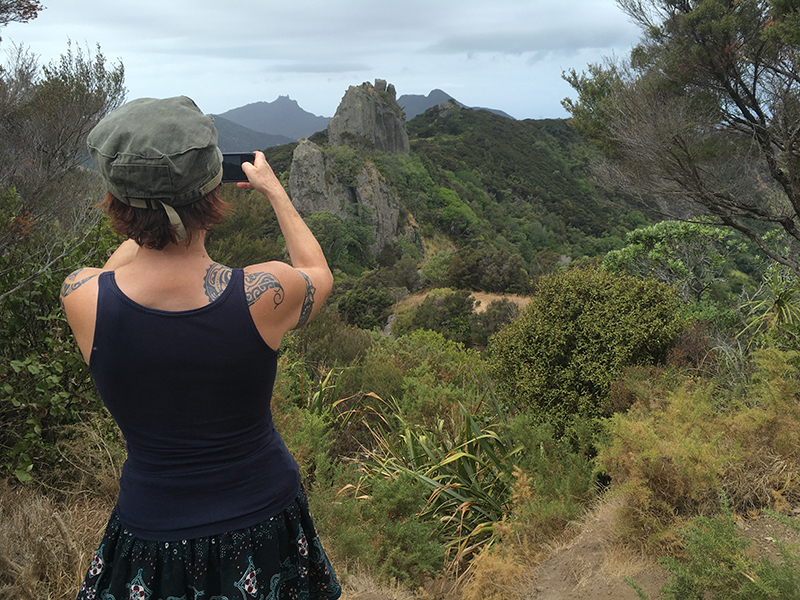
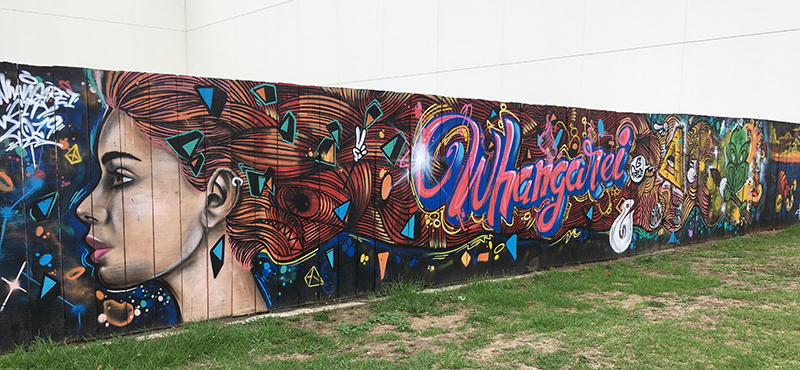
Back in Whangarei, Wendy and Idid some nice walks in the Whangarei Heads area. We walked to Smugglers cove and Bream Head and also over Mt Aubrey with its dramatic pinnacles.
Smugglers Cove
Mt Aubrey
We paid a visit to Tutukaka and the marvellous coastline there walkingfromMatua bay tothe glorious Whale bay taking in a gloriousswim here.
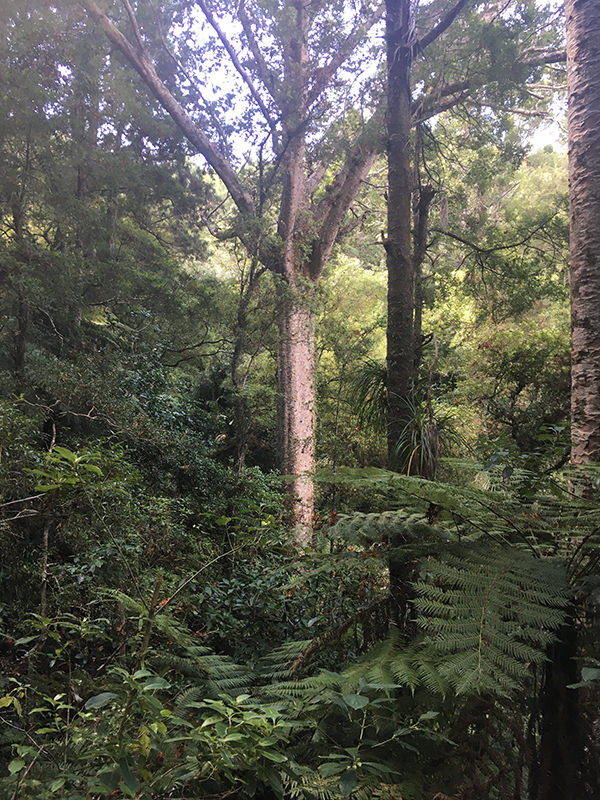
Closer to Whangarie we walked along the Matea river to visit Whangarei falls with a swim in the pool here and a walk along the tree walk of AH Reed memorial park with its large Kauri trees.
Whangarei Falls
Wendy on bridge over Hatea river
Hugging a Kauri
All too soon Wendy’s time in New Zealand was up and I was left once again to my own devices.
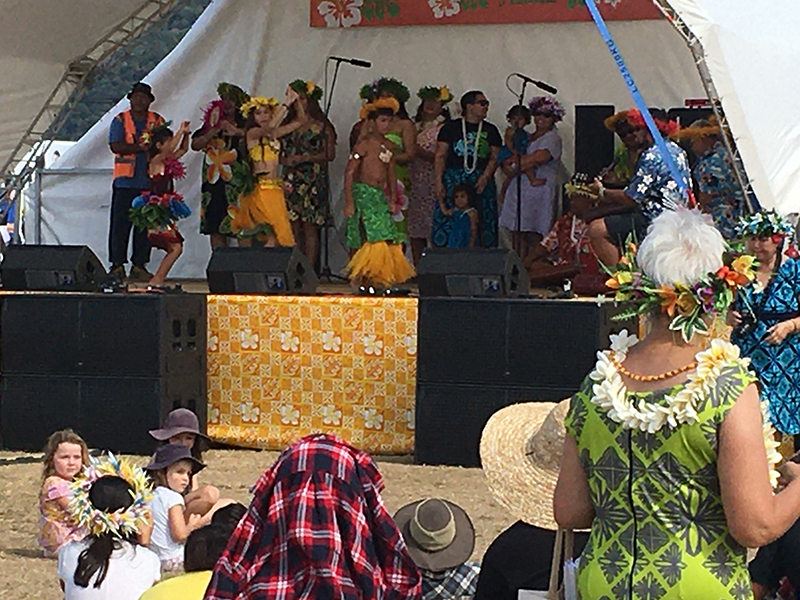
The Pasifika Fusion festival provided diversion for a day with lots of dancers from the Pacific islands.
Pasifika festival
I walked the Hatea loop several times, shopped at the growers market for fresh fruit and veg, drunk Flat whites in town but alsomore energetically cycled the cycle track along the estuary and through the mangroves to the jetty at Onerahi.
On the Hatea loop
Waka Sculpture
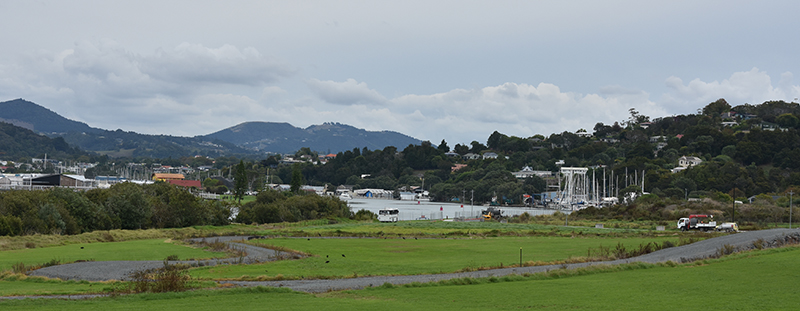
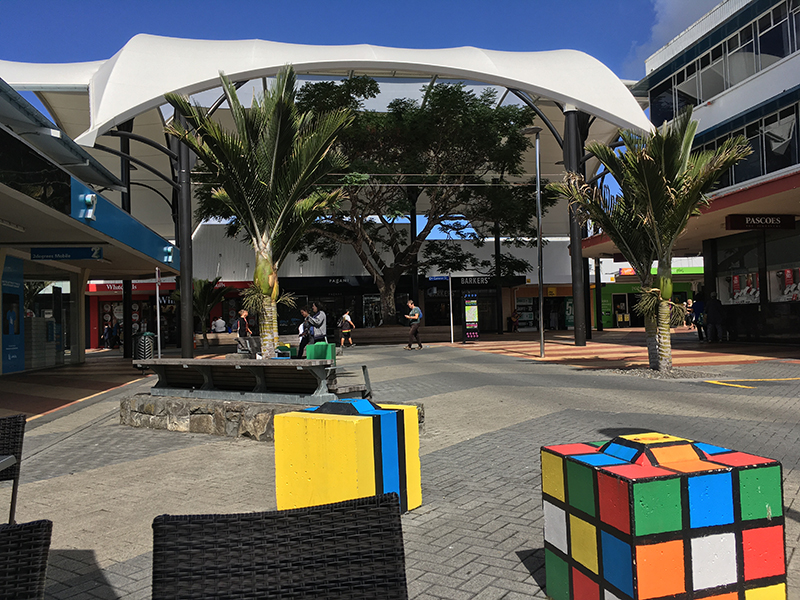
Whangarei town centre
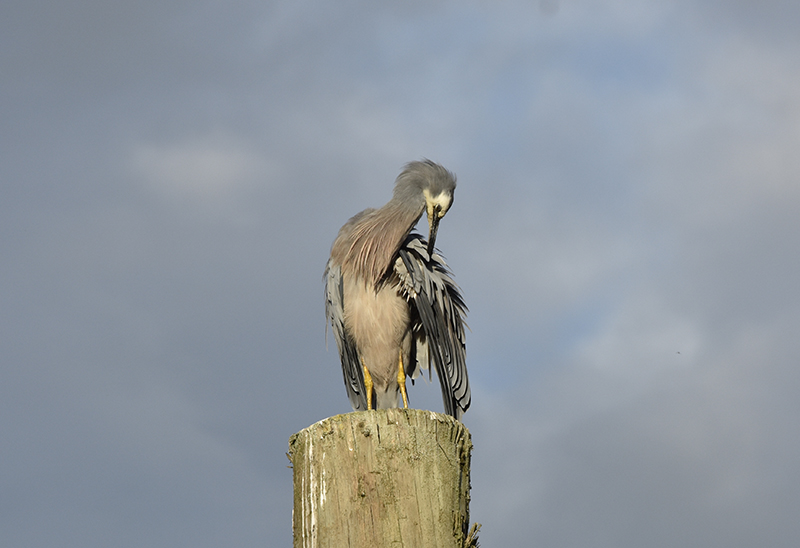
Heron preening at the marina
Another day I walked up to the Abbey caves, an area of caves and eroded limestone boulders which was interesting to explore.
Early morning swim Hatfield beach on way from airport
Wendy had arrived for a visit, we made use of the campervan to go to the Bay of Islands music festival in Waitangi then visited Kerikeri for waterfall walks then across to Hokianga harbour and down through the Waipoua forest and the giant Kauri trees. Back in Whangarie it was time to go sailing again.
Leaving the marina just before midday, at the top of the tide, we slipped the mooring warps and headed off down the river, under the Hatea bridge and away. We anchored for the evening in Urquharts bay, cooked tea and relaxed in the cockpit with a sundowner. The forecast for the morrow looked good for the crossing to Great Barrier island with fine weather and westerlies of 10 to 15 knots. We left at first light, the weather was fine but the winds remained light all day. We did fly the cruising chute for a while but progress was to slow to ensure a daylight arrival so we ended motoring most of the 40 mile passage. Late afternoon saw us anchoring in Nimaru bay, Great BarrierIsland.
We moved next morning, sailing around Maunganui point where the wind was strong and gusty and the sea a nasty slop, into the calmer waters of Port Abercrombie and thence to Forestry Bay, Port Fitzoy.
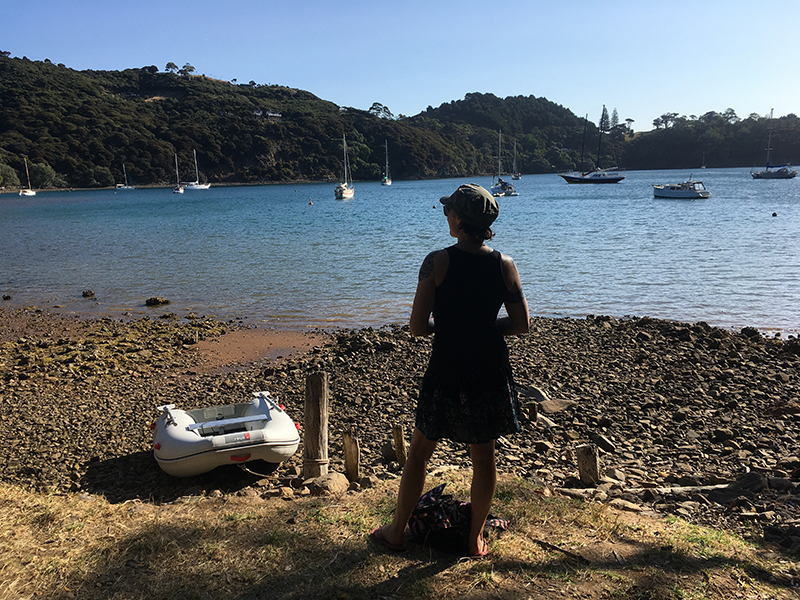
Dinghy landing Forestry bay
Here we rowed ashore and followed the Bridle track first to Port Fitzroy itself then returned to the junction with the Warren track up the waterfall. Farther than expected the timings on the track signs being a bit out. The waterfall itself was a little disappointing – reduced to a mere trickle on account of the drought. Next day a walk took us around to Kiarara bay and a walk up the old forestry road.
Forestry Bay
Back at the boat we made theshort hop to anchor in Kiarara bay . It was very windy the next day so we stayed put.
Moving on again to Kiwiriki bay, a lovely bay this, rocky islands by the entrance and wooded hillside all around, no roads no houses. We did a couple of walks whilst here on the Kiwiriki track. One up towards Maungapiko and the other up to Coffin creek and thence to Kiarara bay. Other times we played about in the dinghy and on the paddleboard.
Kiwiriki bay
After a few days we moved back to Port Fitzroy, anchoring in Forestry bay again. A walk to Port Fitzroyand up to Lookout Rock rewarded us with fine views and later with bread and fruit from the shop and a delicious burger and chips on the quayside.
Lookout rock above Port Fitzroy
Great Barrier island is off grid, there are few roads and no mains power, poor or non-existant phone signal. Residents rely on catching rain water for their water supply. It is a lovely largely unspoilt place though was once heavily logged for the Kauri trees.
We could have happily stayed there longer but decided to return to the mainland whilst conditions were good. It was calm as we motored out from Port Fitzroy but later the wind kicked in a little NW at first then later it switched to West 17 knots dead on the nose then to SW.
9pm and just dark as we anchored in Uruharts bay , a long tiring passage.
Next day we took the tide back up the river to Whangarie, under the bridge and moored alongside at Riverside drive marina again.
By now I had planned to be back home in UK but I found myself trapped in NZ with the lockdown.
Corona virus pandemic was starting to grip the world and the NZ government was taking early and tough measures, announcing self quarantine measure for arrivals in NZ and soon following up with a ban on non New Zealanders arriving in the country. At this stage there was only a handful of cases in NZ and with the testing programme they knew that all the cases were people who had come to NZ from infected areas. As soon as there were two cases that they thought might be from community transfer they announced a level 4 lockdown. All cafes & resteraunts and shops apart from supermarkets closed and all business to close. Everyone to stay at home in their own bubble and with no non-essential travel, allowed out only to go to the supermarket and for local exercise.
Although the British govt was urging all Brits to return home, this was impossible – there were no flights and almost all the transfer hubs for flights had closed.
The morning of the lockdown (25th March), was eerily quiet, gone where the sounds of work in the boatyard, traffic on the roads very light and very few people on foot.
The Hatea loop, a 4.2km cycle and walk way that loops from the Town Basin and canopy bridge and down one side of the river crosses the Te Matau a Pohe bridge (fishook in Maori) and back up the other side, normally very popular and busy, was virtually deserted.
Te Matau a Pohe
As well as the Hatea loop, I am lucky that right on my doorstep is the Parihaka Scenic Reserve. Parihaka is an eroded volcanic cone 241m high and there are 3 tracks up it. From the top there are marvellous panoramic views over the town & harbour and right down the estuary to Whangarei Heads. My favourite is the Ross track, from the end of the tarmac, the track follows the stream ascending by the side of a small waterfall by a wooden staircase. The track carries on up through the native bush and there are anumber of Kauri trees. Opposite the largest of these is a handy bench for contemplation. I generally push on preferring a non stop ascent. Sometimes I stop in descent when I generally take it slower anyway to ease the creakey knees, legacy of a lifetime of bashing up and down the mountains.
Kauri tree on Ross track
The other tracks start by following the Hatea river, there is a boardwalk through a mangrove swamp then up through the woods before branching up the hillside. Near the top of the Dobbie track are the remains of a Maori fortifications (a Pa site).
It is a good circuit to ascend and descend by different tracks and switch ways up to add to the variety.
My other form of exercise is on the bike, a folding Brompton. A couple of circuits of the loop or taking the 10km Onerhai cycleway/walkway which leads to the Waimahanga walkway, a track following the estuary and partly the course of an old railway line.
All in all it’s not to bad being stuck here in Whangarei, I am probably better off (and safer) here than in the UK at the moment. I was looking forward to being back home and catching up with every one, I am missing my family & friends back in UK. The future is full of uncertainty but others are in a worse situation than me and my thoughts go out to them.
The Covid 19 epidemic has forced many sailors and cruisers with hard choices, with lockdowns, closed ports & borders and a ban on sailing having an effect. Some have been stuck in one place unable to move, others for example those in the Caribbean have been faced with a difficult choice either to remain where they are and risk being caught up in the hurricane season or to make the trip back to Europe. My friend Thom for example, not allowed ashore in Antiguaheaded for home. He is currently in the Azores where he is receiving food and support from Peter Cafe Sport in Horta, but he is not allowed ashore. He awaits better weather to head off for the remaining leg back to the UK. Others have been mauled by bad weather in the Atlantic, two arriving in the Azores having being dismasted.
Others have just had to stay put.I have friends who have had to cancel their sailing plans for the year and remain either in New Zealand or Australia.
I consider myself as one of the lucky ones really. Yes I was stuck in lockdown in New Zealand, but it wasn’t a bad place to bestuck at all and the government there took early and effective action to both limit the spread and effect of the pandemic. Indeed as a write this (5th June) they have had no new cases of infection there for 14 days.
I made my hard choice actually some time before the pandemic truly hit. I had been single handing for 5 years and the past season cruising amongst the Pacific islands I had been thinking of giving up on single handed long distance cruising for a while. There were number of reasons for this, some personal and some practical. Don’t get me wrong I still loved sailing and exploring, particularly in the Pacific and did this mean giving up on my circumnavigation, but somehow it felt time for change.
I considered a number of options included selling up or keeping the boat in NZ, but in the end I decided on shipping Sea Bear back to the UK and I had actually set this in motion before lockdown happened.
Originally shipping date had been for March but this gradually slipped to May.
I was posed with a number of difficulties. Shipping was from Auckland, Sea Bear was in Whangarei 100 miles away. Sailing was not allowed under lockdown and was enforced. Marinas were closed. If Sea Bear was shipped I would have nowhere to live. There were no commercial flights from NZ to UK. I faced being stuck and homeless. To cancel or postpone shipping would have meant losing my substantial deposit
For a while these difficulties seemed insurmountable and caused considerable stress and worry. However quite suddenly and in the space of a week they were all solved. I was granted permission to sail to Auckland, a marinaagreed I could stay there and the final piece of the jigsaw I was offered a repatriation flight back to the UK.
So preparations all made, and with mixed feelings, midday high tide on 28th April saw me slip the mooring lines at Riverside Marina, say farewell to my friends there and head off down river bound for Auckland. I was on a fairly tight schedule with just 3 days before my flight out so I decided to push through the 90 mile passage non-stop. Apart from a bit of wind over tide nastiness at the mouth of the river, conditions were pretty good. Sun & clouds with a S-SE breeze about 15 knots, though of course here that wind is blowing straight from the Antarctic so is cold. Later the wind picked up a bit so reefed the main and yankee. The forecast dropping off the wind happened around 1 am and then died completely, time for the engine.Entering Auckland harbour around 9am, the police launch arrived alongside for a chat but were quite happy, I had already phoned them earlier to notify them I was arriving. Soon I was making fast in Bayswater marina in my allotted berth.
Arrived in Auckland
There were quite a few live-aboards on the pontoon, all very friendly and we had some suitably social distanced conversations.
Bayswater Marina, Auckland
I was pretty busy for the next days, preparing Sea Bear for shipping, stripping off the sails, canvas work and running rigging and clearing out the food lockers and other such stuff.
Sea Bear stripped of sails and canvas work
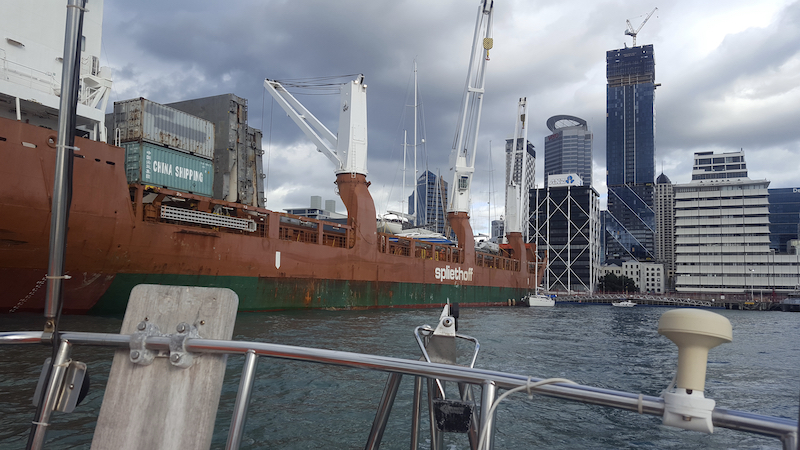
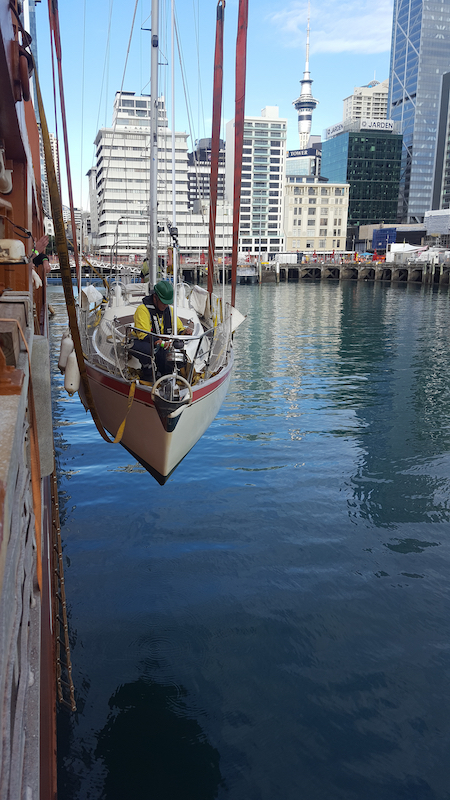
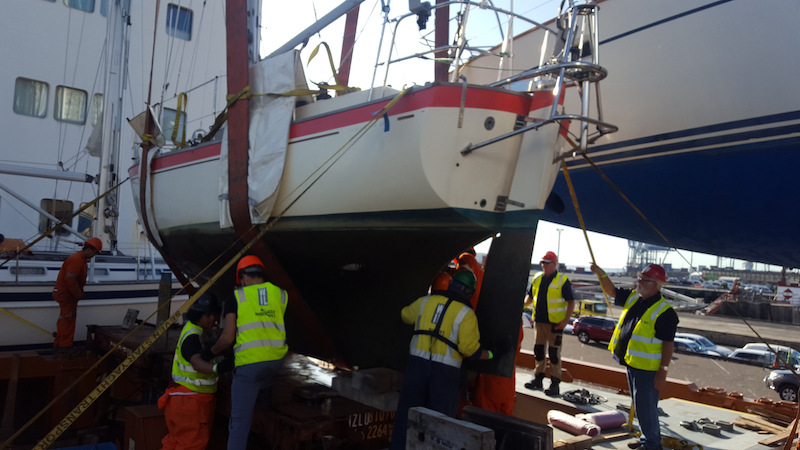
My last problem was that my flight was before the loading date for Sea Bear. The agent suggested someone to help but Steve, a live-aboard a few boats from me offered to deliver Sea Bear to the mv Minervagracht for me. I gratefully accepted and I knew I would be leaving Sea Bear in a safe pair of hands.
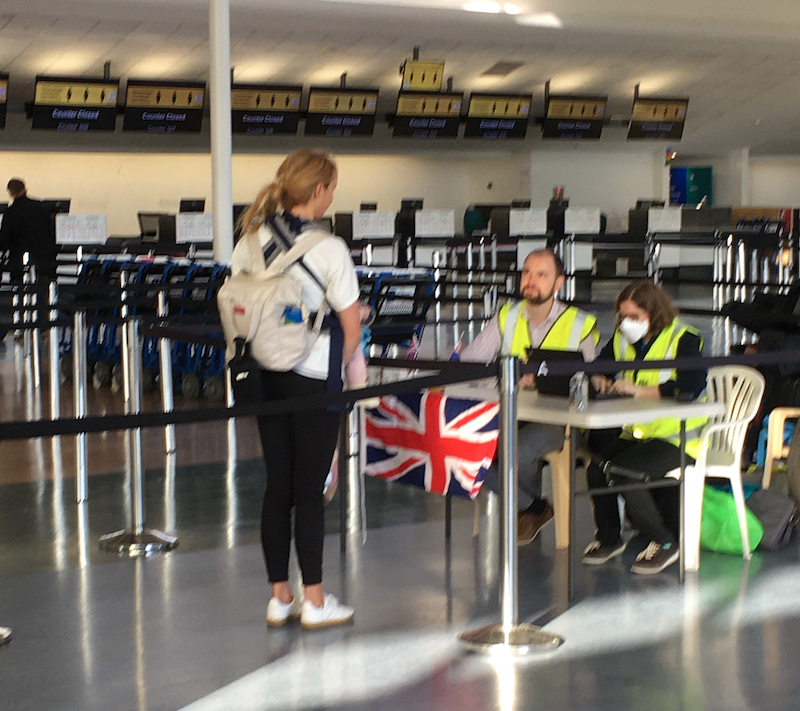
Repatriation flight check in
Flying out was a bit weird, I’d booked a shuttle service to pick me up from the marina, I was the only passenger. Auckland airport was pretty much deserted. Our temperatures were checked before check in and again on 2 hour stop-over in Hong Kong where we were held in effective quarantine. It was a Heathrow that the shambles started and after disembarking we were held for a long wait in a corridor before passport control – not passport control mind where they had laid out queuing lines with provision for social distancing but in this corridor where they allowed passengers from flights from USA and India to pile upand try and push past. It was a bloody shambles. Hell what was I coming back to?
I hired to car to get back home so avoiding public transport and the flog across London with luggage, tube, trains etcand not much more expensive than outrageous railway prices, I didn’t even know if any trains were running. Very strange to drive along an almost deserted M25 and M1. So back home and adjusting to life ashore in the midst of badly managed pandemic in a country with the second worst death rate in the world. World class don’t make me laugh – top of the list for incompetence and mismanagement.
Sea Bear is due back in UKat the beginning of July.
There comes a time in a sailors life when he knows his experience is not complete until he has dryed out his boat alongside. Oh I know bilge keelers and such do it all the time, but it is a bit different if unsupported by either water or a wall your boat will fall over on its side. For a drying out virgin like myself the process is fraught with uncertainties and doubts. However the time had come. Due to some oversight Sea Bear’s new copper coat anti fouling had not been burnished before launch. In consequence her bottom showed a unhealthy growth of weed, it needed a scrub off, I could no longer delay or prevaricate despite my trepidation.
I was cruising the Isle of Man and had never visited Ramsey, a drying harbour, before so here was the perfect opportunity to kill two birds with one stone as it were. Communicating my needs with the harbour master, he directed me to a suitable wall alongside which to tie up and await the falling of the tide.
I had of course read all about the process of drying out alongside, so went about my preparations carefully. Warps prepared, plenty of fenders, a line from the mast to ashore and anchor chain laid out on the side deck. Watching the depth sounder never before did it seem that the tide went out so slowly and I paced the deck nervously gradually easing the lines just so, tight but not too tight.
I wasn’t aware of the precise time that Sea Bear settled on the bottom, so gentle was it but soon the water level was low enough. Donning wet suit and wellies and clutching a brush I slipped over the side and scrubbed and scrubbed. The interesting bit was crawling between hull and wall and when I was done I must have looked and smelt like some wild merman with seaweed in my hair. Weed cleared I could then do what should have been done before launch and abraid the epoxy of the copper coat to expose the copper so it could do its job. Eventually all was done, pleased and relieved I could await the incoming tide with a glass in the cockpit, another part of my sailors education complete.
I was determined to get to the boat this weekend , the last 2 weekends weather having been so bad.
It started raining when I arrived at the slip on Friday. Launched the dinghy, started the outboard but no drive – sheer pin had gone. The carefully sorted outboard fix kit was on the boat though. Ok so I row out to the boat, in the rain against wind and tide. Poor vis and rain rest of day so I stayed on the mooring.
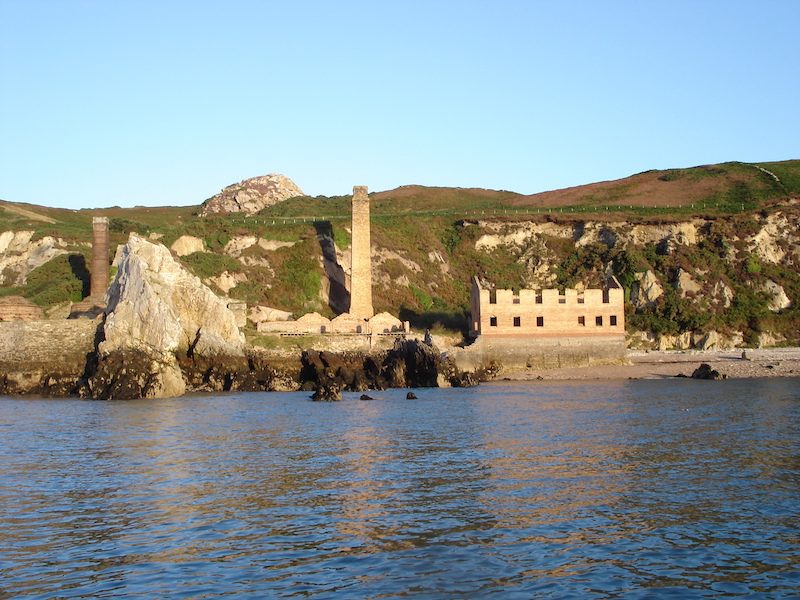
Saturday HW was early so I caught a halftide and went to Moelfre, with lots of tacking across Red Wharf bay against a W wind. Here I anchored for lunch before continuing on to Porth Wen, more commonly known as Brickworks Bay from the old brickworks there. It is a lovely spot and I had the anchorage to myself.
Brickworks, Porth wen
Sunday morning and the wind had picked up SW 4-5 v W and increasing 6-7 for a time they said. I think they meant all day. It certainly felt strong as I struggled to haul in the anchor. Back to the Straits under yankee alone. Past Point Lynas and then across Red Wharf Bay was a nasty sea, short steep waves close packed. The wind was picking up a notch or two. Through Puffin Sound was horrendous, I have never seen or experienced it so bad. I don’t know whether it made me feel better or worse watching another yacht following me in, launching skywards from the crest of the standing waves and crashing down in a welter of spray. I wished I could have left the tiller to grab a camera. Eventually I was back at the mooring but it took several attempts to pick it up. It had not been a particularly pleasant days sailing. It don’t feel like Summer.