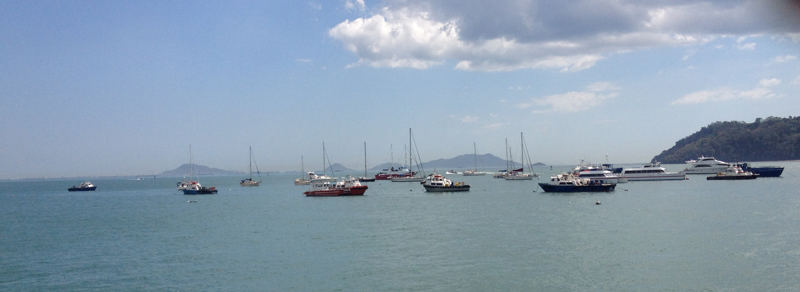
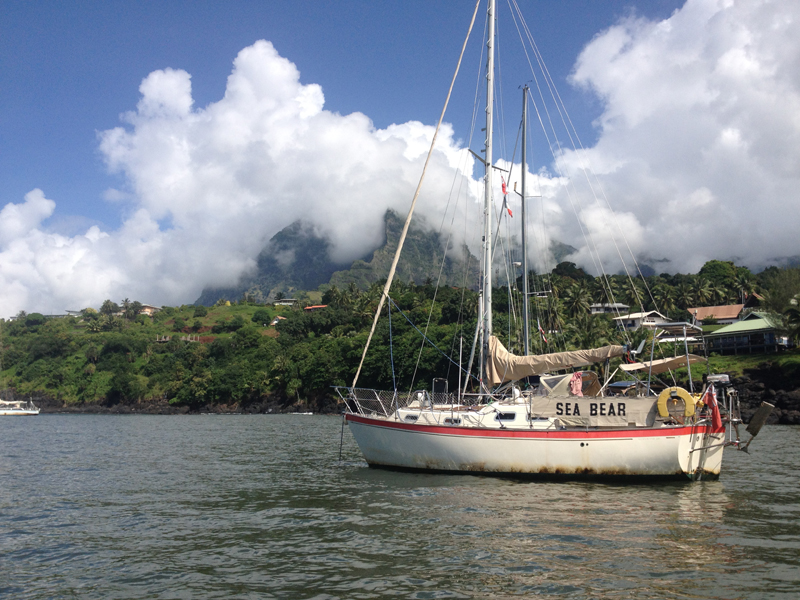
I spent a few days at the Balboa Yacht Club moorings, I had been led to believe that they were very rolly with wakes from big ships but I found this not to be the case at all.
Balboa yacht club moorings
Making final preparations for the Pacific I spent some time visiting several chandlers but I couldn’t get all the bits I wanted which I found a bit surprising in such a big place. I did in the course of my wandering use the Metro subway, very fast and efficient in addition to taxis and the metro bus.
Las Brisas and Panama City
I did get a chart for Tonga which I was missing and a new Nautical almanac from Islamoradora the excellent chart agents in Balboa.
Balboa monument
I went to the open air vegetable market at Abastos which was huge and bought lots of good quality unrefridgerated fruit and vegetables which keep much better than cold stored supermarket ones for the journey. Another purchase was a new windup kitchen timer – just the thing to time your catnaps at sea, though I wont be able to doze with it on my chest as used to be my wont with my old one as it it egg shaped and so would roll off. International zarpe got from the Port captain at Flamenco and Immigration visited, I went to get diesel topped up and whilst moored up some clot in a work boat who was moored astern decided for unknown reason to reverse into me. There was a horrible noise and the wind vane paddle was horribly bent. I was fuming as you might imagine. The design of the monitor is such that there is a sacrifical tube between paddle and gear mechanism and it was this that was bent. I do carry a spare but I wasn’t about to tell the other boat that. A yacht club offIcial on the fuel dock was helpful taking all the details . I took off the paddle and stripped out the tube giving it to the guy on the dock who said he would insist it was fixed today as he knew I was leaving. I went back to the mooring to wait. They came by later but it was still not quite straight so he went away again. They came back later with a new one which was a better result and I have also got the old one which is not quite straight but will do as another spare at a pinch. Have just finished putting it back on which involved some slightly dodgy sitting on the back framework. All ready now think I need a beer after all it will be last one for a while. First stop is planned for Las Perlas islands about 40 miles away then it will out into the Pacific proper for the long haul.
Left Balboa moorings at first light and after motoring out of the channel set a course for the Las Perlas, a cluster of over 20 mainly uninhabited islands about 40 miles away. Little wind so mainly motoring until later on when I picked up a southerly breeze. I eventually anchored off the NW coast of La Contadora, the busiest of the islands, a weekend retreat for rich Panamanians. Next day I moved on to a lovely anchorage in the channel between Isla Espiritu Santo and the main island of Isla Del Rey. Supposedly a popular anchorage but I had it all myself, it was very peaceful, lots of pelicans and parrots.
Espiritu Santo
Now I could start the task of diving under and ensuring the hull was clean before passage and that afternoon I got 1 side done but I find it tiring work. Wanting to finish the job off next morning but the tide was running swiftly past the boat and I decided it wouldn’t be wise. Yes welcome back to tides, something you almost forget about in the Caribbean, here the range is about 15 ft. I therefore moved on, motoring down the east side of the islands to almost the southern end. Here I anchored at Rio Cacique which the pilot assured me you were almost certain to find flat water. So it was I and I finished off the hull cleaning.
A quick dive next morning as a final check then it was time to leave, this morning at least there was some wind and from the North so I set off for the long passage bound for the Galapagos. Probably like many other cruisers I had some regrets at not having more time to spend exploring in these delightful islands but the Pacific beckoned.
I did have a calm patch passing between wide gap between Isla Galera and Punta Gorda but then the wind was back. A notable sight was the sting rays jumping vertically from the water, turning end over end and landing with an almighty splash.
So the day passed and the first night, lots of big ships bound to and from Panama but all a good distance off. I was off to a flying start because in the first 24 hours Sea Bear had run 130 miles. However it was not too last and the winds grew lighter and lighter with some periods of calm. I don’t think I saw winds over 8 knots again. So the days passed, once clear of the shipping channel there were no ships and little to do apart from ring the changes with the sails, pole out the yankee opposite to the main, lets try the cruising chute, the occasional gybe to keep on course as far as possible, a little tweak to the self steering now and again. On the 8th day I was a little surprised to see a fishing vessel must be 200 miles at least from the nearest land.
After sunset of the 9th day and a big bird made a determined effort to land atop the mast, succeeding after several attempts. I guessed it must be a land bird as a sea bird would just settle on the water, but I wasn’t able to identify it, it perched there all night leaving with first light in the morning.
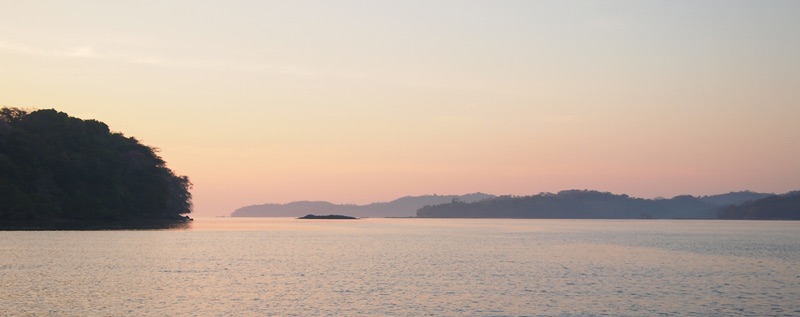
sunrise coast of San Cristobal
My patience with these calms and light winds was wearing thin so nightfall of day 10 when it fell calm and there was about 50 miles to Isla Cristobal I resorted at last to the engine. It didn’t help that the auto pilot had packed up so hand steering it was. The wind did return for a while but not for long and when it died again I let let drift and took a 30 minute nap before turning on the engine again. It had been a lovely full bright moon night but eventually it sunk below a thick band of clouds so it was really dark, now I know there is an island somewhere hereabouts. First light and all was revealed and I was shortly entering Wreck Bay there to anchor. It had been 10 days short 1 hour for the 838 mile passage.
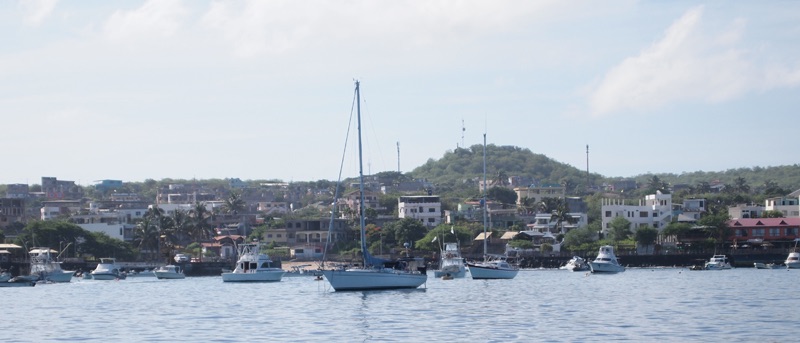
I was a little surprised how green was the island after all I had read. Plenty of trees and vegetation, but then I suppose it was the rainy season. First thing after anchoring was a dive over the side to check the bottom of Sea Bear, it had accumulated a crop of goose barnacles so those were scrapped off. A big boxy fish (puffer fish) came along to help, tugging them off and eating them. Formalities took some time to complete, it all has to be done through an agent . At one time there were 6 official aboard plus a diver inspecting the hull. It was all very friendly though and no problems although expensive, I just had to be fumigated in the morning. For that I had to be off the ship for 3 hours so I explored the town, watched the sea lions, swam at the beach and found a nice restaraunt for a 4$ fish meal.
Wreck Bay
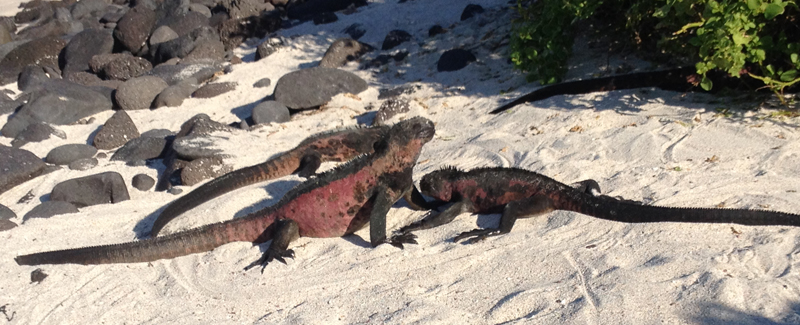
Subsequent days saw me walk to the beach and Lobelia for my first sight of marine iguanas, more sea lions of course, this place is ruled by sea lions. Birds including the famed finches, a lava heron, white checked pintails, oystercatcher, a plover and of course plenty of pelicans and frigate birds. Another day I took the bus (they only run on a Sunday) across the island passing through the farming area of El Progresso to La Galapaguera, a breeding project for giant tortoises a walk around here and then on to Puerto Chino, the end of the road and a walk to another lovely beach. No sign of a bus back so after a long wait I rode back in the back of a pickup truck which is what all the taxis here are. Boat maintainance carries on, this time it is major re-stitch of the seams of the spray hood where the stitching has either frayed through or rotted by sunlight and sea air. Its hard awkward work. There is only the one road so some days later I rode my bike up past the highest point, Cerro San Joaquin (896m) to El Junco where I walked up to see the crater lake. That was some hard ride but much easier freewheeling back downhill. I got soaked in a downpour but you don’t get cold here near the equator so it barely matters. Leaving Sea Bear at anchor I took a launcha (fast motorboat with 3 big outboard engines that do the 40 nm trip in about 2 hours) over to Puerto Ayora, Santa Cruz to meet up with my son Ged who flown into the Galapagos. We visited the Darwin centre and walked to Turtle bay then managed to arrange a few days on a tourist boat. This was very good indeed, food superb and the wildlife guide very knowledgable and informative. We visited giant tortoises in the highlands of Santa Cruz then the boat took us overnight to island of Espanola where we walked ashore on Gardner bay for sea lions and marine iguanas, snorkeled in the bay seeing turtles. On then to Punta Suarez for a walk across the peninsular though marine iguana breeding sites and masked booby colonies.
Marine Iguana
Gardner Bay Española
Land Iguana Santa Fe
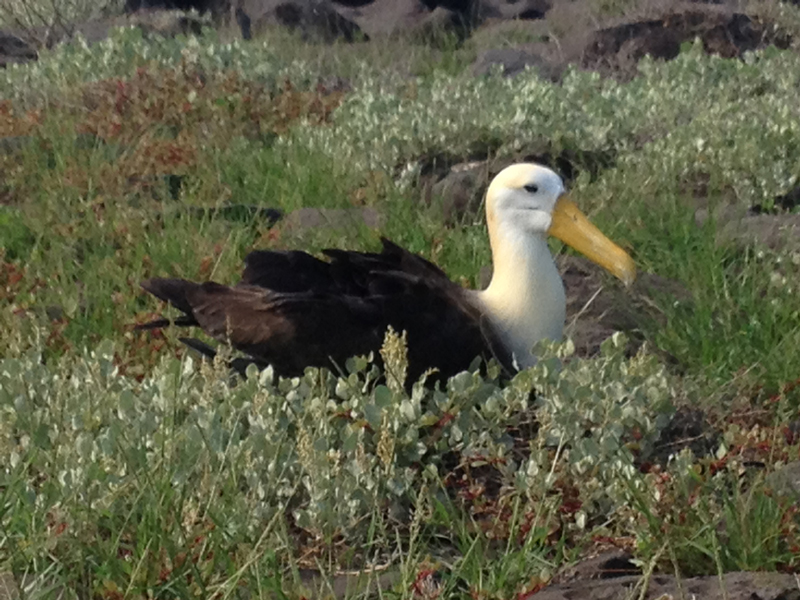
Even though it was a little early in the season we were lucky to see one waved Albatross.
Waved Albatross
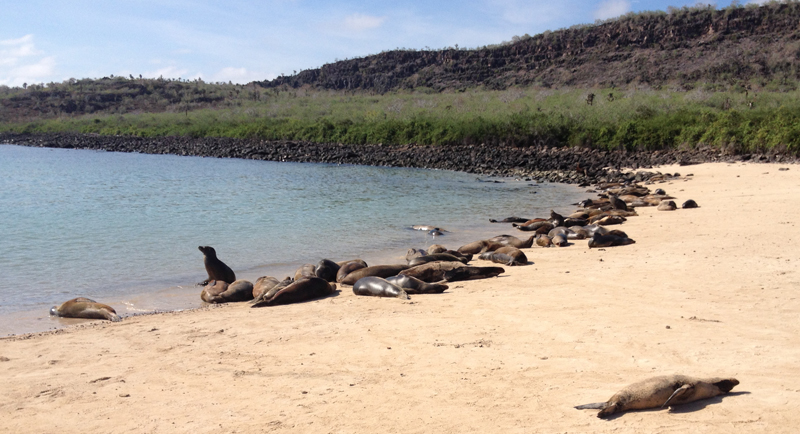
One of the features of the Galapagos is the fearless nature of all the wildlife meaning that you can approach really close which is very special. Here we also saw the Galapagos hawk. Next was island of Santa Fe for the cactus trees and land iguanas found only on this island. Then to South Plaza, a different type of landscape, a different type of iguanas plus nesting on the cliffs, swallow tail gulls, blue footed boobies and Audubon’s shearwaters. Throughout there were frigate birds , tropic birds, finches, mockingbirds and Galapagos doves. Tour finished we bussed over Santa Cruz to Puerto Ayora and Ged and I returned by launcha to San Cristobal to rejoin Sea Bear. We had a fabulous snorkel in a rocky cove underneath Cerro Tijeretas with big schools of fish, many brightly coloured big fish and with sea lions swimming really close to you.
Sea Lions
But my time in the Galapagos is up, it has been fabulous, but now its time to arrange my zarpe, clear immigration, stock up with water, veg, fruit and bread and head on out for the Marquesas. They are about 3,000 mile away so 30 days or more.
I had a what I think to be a very slow passage following just about the great circle route which differs not a lot in these latitudes from the rhumb route. I’ll not bore you with the full details but I can understand why Connor O’Brien, who was the first Irish yacht circumnavigator, said if he had to sail 5,000 miles in the trade winds that he would die of boredom. Still as the great Moitessier said, cruising is one long game of patience.
I’ll just add trade winds what trade winds! The pilot books had assured me I would be gently wafted from Galapagos to the Marquesas by the SE trades
Leaving the Galapagos I had no wind then a succession of squalls , one which caught me unawares on a grey drizzly morning when the wind went from 10 knots to 35 – 40 in a matter of moments and torrential rain. It was one of those moments which bought to me how alone you are out here and far away from any help. Then the weather improved for some days but I still had a series of grey overcast days with no sight of the sun. The winds were light many days of 8- 9 knots of wind and sometimes lower. At first they were indeed from SE, living up to their name and we could sail along on a broad reach but then they went E even NE so it was dead downwind, a point of sailing that neither Sea Bear nor I agree to like and there was always enough swell to create at times, lively rolling which was tiresome.
It amazed me how quickly weed and barnacles grow on the bottom in these waters. I had started out clean but after a week already had a fair growth and it doesn’t take too much to slow the boat down and make her sluggish and unresponsive on the helm. One day when the wind was only 3 knots i did launch the dinghy and try and scrape some away but there was too much swell and I adjudged it too dangerous.
There is very little boat traffic this way and I only saw 3 boats, one a freighter and two fishing boats, still with a guard alarm set on AIS it does mean you can get some decent sleep.
The last few hundred miles seemed to take forever, I think i know what its like to be in limbo now.
The penultimate day around midday I spied land, at first not quite sure, was it cloud but no a bit later I was certain Land Ho. The Marquesas are high mountains and I was still 45 miles off.
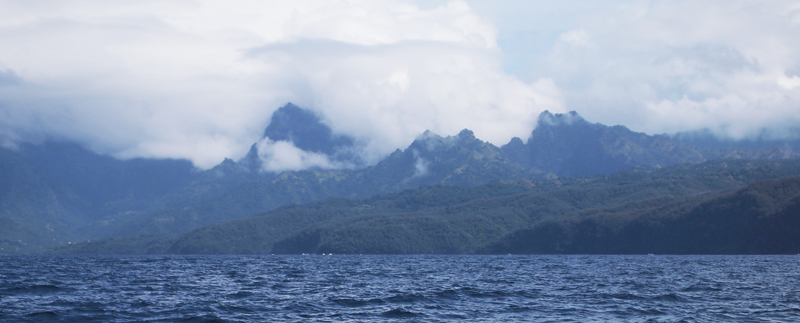
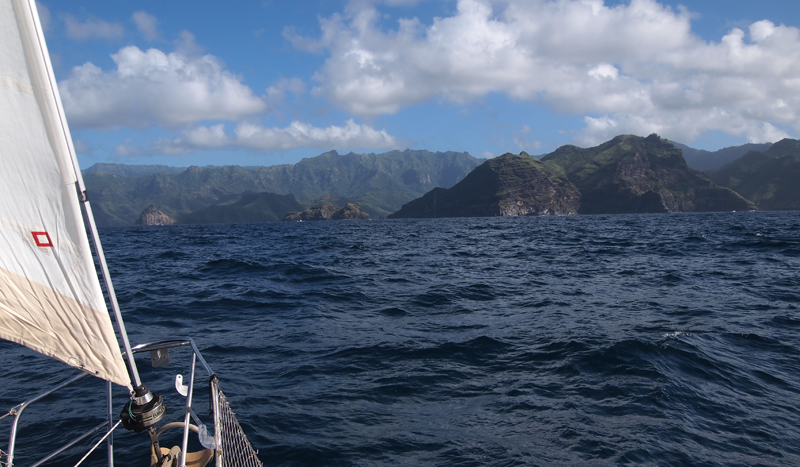
There was no chance to get in before dark that night so when about 20 miles of I hove too and drifted slowly towards them. Dawn I let draw again, what magnificent islands steep mountainous and verdant and largely unspoiled.
Approaching Hiva Oa
Later as I turned into Atuona Bay, Hiva Oa, I met with Thom on another Vancouver 28 just leaving.
I anchored in the bay, I had made it to one of the most remote group of inhabited islands in the world, Gauguins paradise.
2995 nmiles and 34 days
Hiva Oa Always the first job once the boat is securely anchored is to register with the Authorities. A walk of about 3 kilometers took me to the town of Atuona. At the Gendamarie I discovered that the time zone here is half hour different not 1 hour which is the usual step in time from one zone to another, and the place was shut until after lunch. At that prompt a visit to an ATM saw me furnished with funds, but I had no idea of the exchange rate, although the Polynesian Franc notes were very colourful and pretty, and I could have lunch myself, a real treat after so long on the boat. Later formalities were initiated very easily, but I had to post the form the Gendarmes gave me to Papete, Tahiti where I would have to visit to complete things when I got there. Next a visit to the shops and a real treat in baguettes and french cheese, that would go well with my last bottle of french wine as a celebration of arrival. Ooh and some tins of cold Tahitian beer, one drunk on the spot, perhaps thats why the walk back to the boat seemed so long. I spent a few days at Atuona, looking around and enjoying land.
stone carvings at Atuona
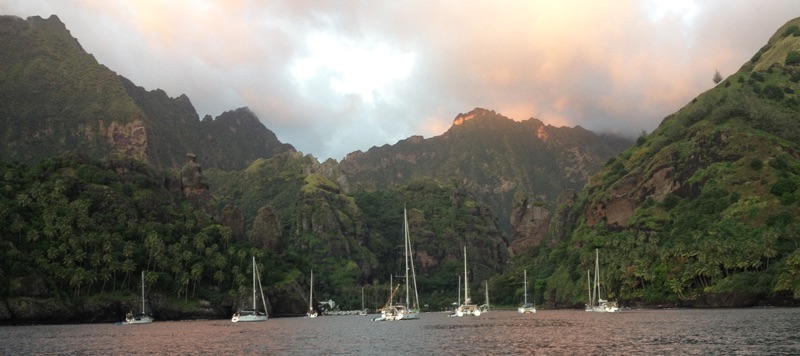
A river emptied into the anchorage bay and it rained a lot meaning the water was very muddy but one benefit of this was that all the fresh water killed off the goose barnacles and weed on the hull. Fatu Hiva Leaving Hiva Oa it was about full moon I thought to have a pleasant moonlit sail to Fatu Hiva. At about 45 miles away it was just to far to guarantee managing all in daylight. It is one disadvantage of sailing in the tropics 12 hour days and 12 hour nights. As it was it turned out very cloudy. Arrived in Baie Hanavave or Bay of the Virgins, a truly spectacular anchorage, steep sided and dominated by rock pinnacles and behind a backdrop of steep high mountains.
Baie Hanavave
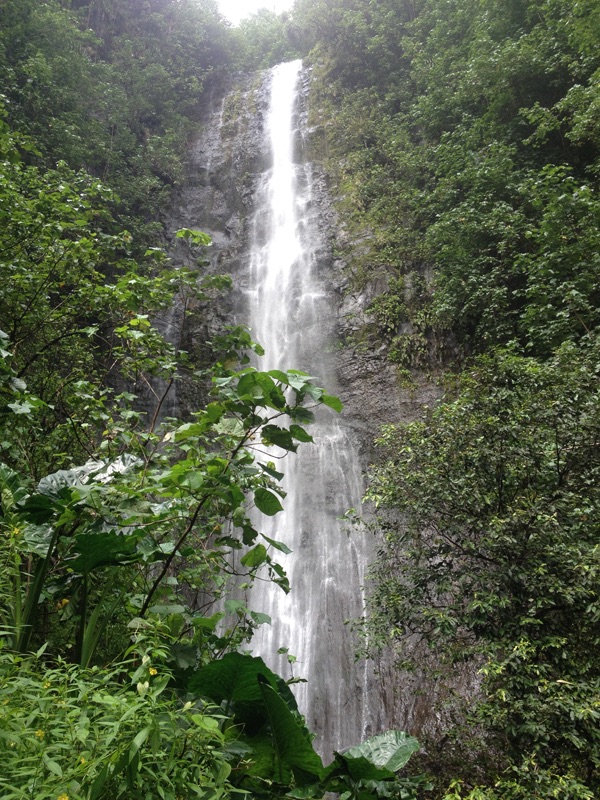
The island is very unspoilt and the people super friendly. Went to a dinner of traditional fare for cruisers anchored in the bay hosted by a family from the village. Roast pork, roast goat, breadfruit, coconut milk, roasted pink bananas & pamplemousse was amongst the items on offer. One day a walk took me to a lovely 200 ft waterfall up the valley behind the village where I skinny dipped in the plunge pool, very refreshing. Another walk took me high above the bay looking down on the boats at anchor.
Waterfall at Fatu Hiva
Leaving Bay of Virgins
Tahuata Another night sail took me to Tahuata where I anchored at Baie Hanamoenoa, reckoned by one authority to be one of the 3 most beautiful anchorages in Polynesia. An uninhabited bay with a yellow sand beach back by coconut palms and a backdrop of green hills. Very soft and gentle by Marquesian standards I thought.
Baie Hanamoenoa
From there I thought to visit a bay on the North coast of Hiva Oa, said to be good for ancient Polynesian sites however after all the light winds I had a day of very strong wind with a big breaking swell so it was not to be and halfway there I changed my objective and headed across the 80 miles to Nuku Hiva. A fairly rolly polly night but an early morning arrival in Taiohae bay. I anchored next to Thom’s Vancouver28.
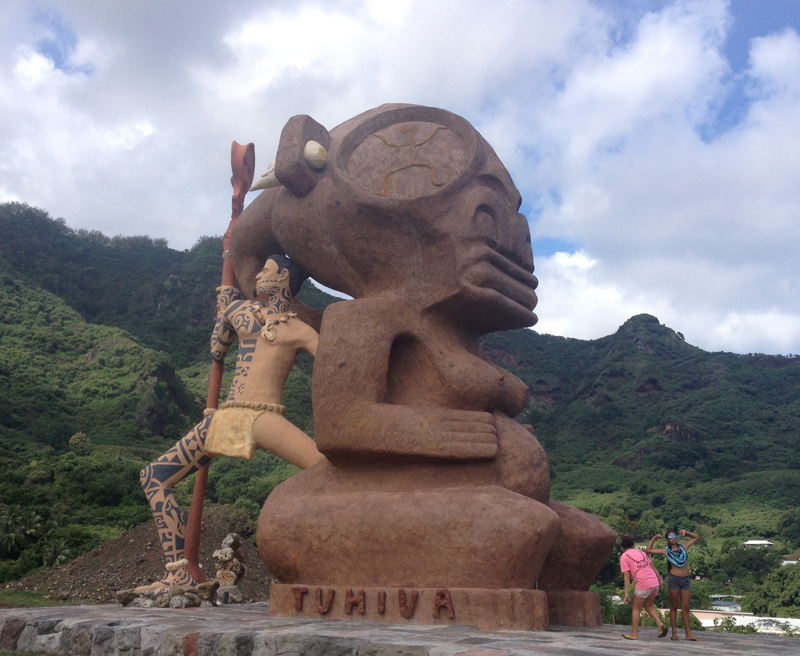
Then bay is very big and able to accommodate lots of yachts at anchor so is a major gathering point in the Marquesas for cruisers. The town ashore is the biggest in the Marquesas so there are shops, a bank, restaurants etc so it is a good place to re-provision and relax. However all the supplies come in by boat which was due in a few days, in between shipments they do run out of things so for the first few day here the shelves were thinly stocked and they had run out of flour so there was no bread to be had. Thom was anchored here so it was good to catch up and compare notes as it were on our Pacific passages so far. We also looked over each other boats which although the same model had a few differences in layout and set up.
Tuhiva
There were also here some other cruisers that I had got to know so it was a fairly sociable time. Whilst here I took a few local walks and had a second go at repairing my leaky dinghy not entirely successfully.
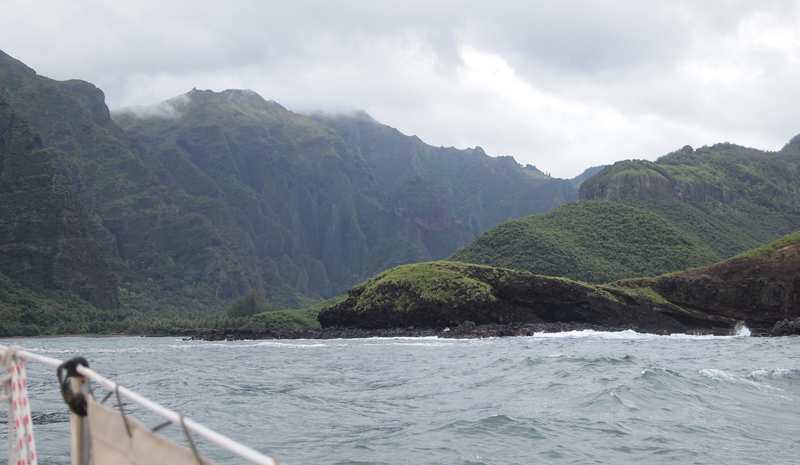
26th-29th May – Baie Tai’oe My next move was to another bay about 5 miles along the coast, Baie Tai’oe. The entrance to this was hidden and looked rather improbable at first entering between a rocky point with breaking waves and tall vertiginous cliffs and with quite a swell running a trifle daunting.
Entrance to Taioa bay
Once inside though it was sheltered, calm and peaceful and you couldn’t even see the ocean.
Taioa bay
Thom arrived next day with a new crew member for me. I had mentioned the other day when a group of us had a pizza together that I was a bit concerned about passing through the Toumotus or Dangerous Archipelego without a crew to watch for reefs and coral heads in the passes and here almost out of the blue was a volunteer to come with me. Beside the spectacular scenery of this bay, one of the attractions was the 3rd highest waterfall in the world being up the valley. Next day I dinghied around to the village of Hakaui, population 10, and walked up the trail to Vaipo falls. The trail was wet and muddy and you had to ford a knee deep fast running river. You were rewarded with a wonderful view at one point before pushing on through the forest.
Vaipo falls
All around were the ruins of ancient paepae or house platforms, at one time the valley must have supported a large population. I got back to the village before it started raining then had an exciting time going back out through the surf to the boat, thought I might get flipped but just took a wave aboard. Went back to th e village next morning and filled my water cans and bought a whole load of fruit, a hand of bananas, pamplemousse, limes and a breadfruit