by chris | Jan 2017 | UK to New Zealand

Finally Sea Bear was re-launched on 3rd January, it felt great to be back in the water. Felt it was time to get sailing again, a few little jobs to finish off but then a set back and had a disaster afternoon.
There was a drain valve at bottom of fuel tank just checking things over looked like it was leaking a bit, investigating and it fell off in my hand so there I was laying in engine bay with my finger stopping the hole where once the valve was. Like the Dutch boy and the dam trying to stop 30 gals of diesel pouring into the bilges Mmm I thought! Anyway someone heard me shouting and came to help so I was able to tell them where a wooden plug and a hammer was so hammered the plug in the hole.
The reducer between tank and valve had been just a mild steel fitting, not fit for purpose at all and had just corroded away. Lucky that it had happened here where I was able to fix it and not somewhere out at sea
Spent rest of afternoon chasing someone down as I need to empty fuel tank so need big drum and pump etc. Eventually all organised and next morning the tank was pumped out, fitting replaced with new valve and tank refilled.
So planning to set of in the morning, just a short hop up the coast to either Portabelo or Isla Linton.
I will also switch on the Yellow Brick Tracker so there should appear a live position of the boat on the current position page.
by chris | Jan 2017 | UK to New Zealand
I eventually got away from Shelter Bay on 6th Jan, winds14-16 knots just right for a shake down sail and seas outside the breakwater after playing dodge the shipping, not too bad. However it took a long time to make Portobello, against wind and current with a few tacks thrown in, about 8 hours for 29 logged miles when the nominal distance is just less than 20. The clearwater buoy marking the entrance to the bay had disappeared since June, probably a victim of Otto and in the bay there were several wrecked boats, Otto being the late season hurricane that had hit the coast further north, the latest and furthest south hurricane ever recorded.
Another teething problem surfaced, this a hole in the heads outlet pipe spraying out dirty water! Though how a hole had suddenly appeared in a 4mm thick reinforced pvc pipe beats me. Shortening the pipe by cutting of the end fixed it but what a struggle to get the pipe back on – took about 3 hours!
Next day the strong winds returned, that have been an almost constant feature since arriving back in Panama. Unless these ease i will not have much chance of making San Blas. After a few days in Portobello I headed of for Isla Linton, just 8 miles away but by the time I arrived logged distance was 19 miles and time taken 5 hours. So much for beating into strong winds and big seas. The entrance was spectacular between surf on the reef on one hand and crashing waves on the rocks on the other hand.
In the morning I dinghied across to the island, didn’t make much progress into the jungle though. Returning towards the beach I was just sheltering from a rain shower under a Palm tree turned around and there were 2 monkeys sitting behind me not 2 feet away. They walked with me back to the beach, I was amazed at how upright they walked. One grabbed me around the legs, I was just a bit wary as had been warned they sometimes bite and one was obviously thinking of some monkey business.

Puerto Lindo

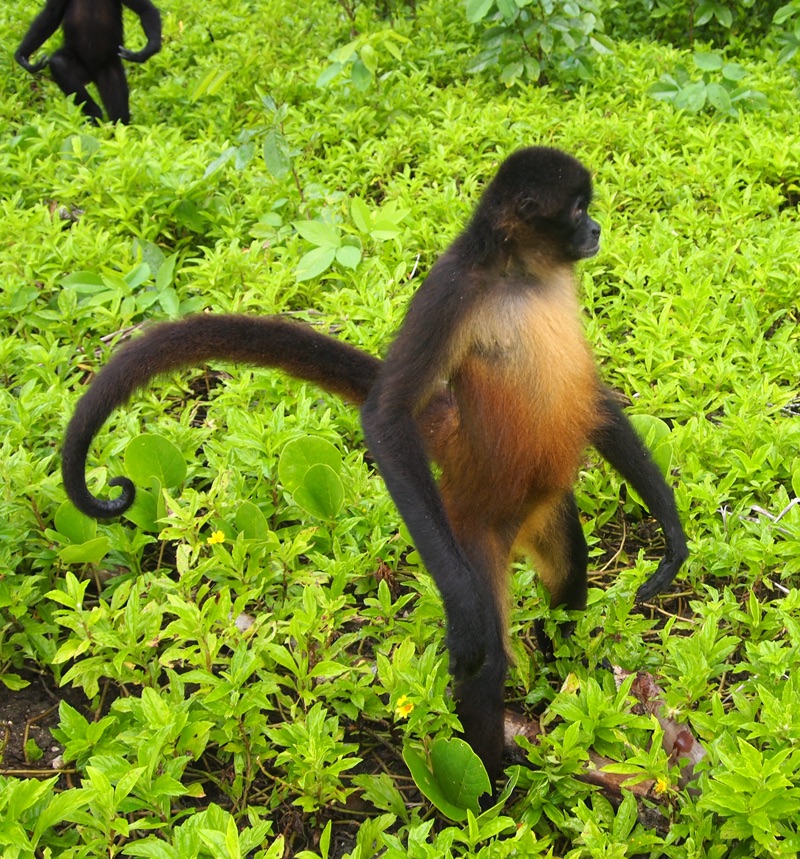
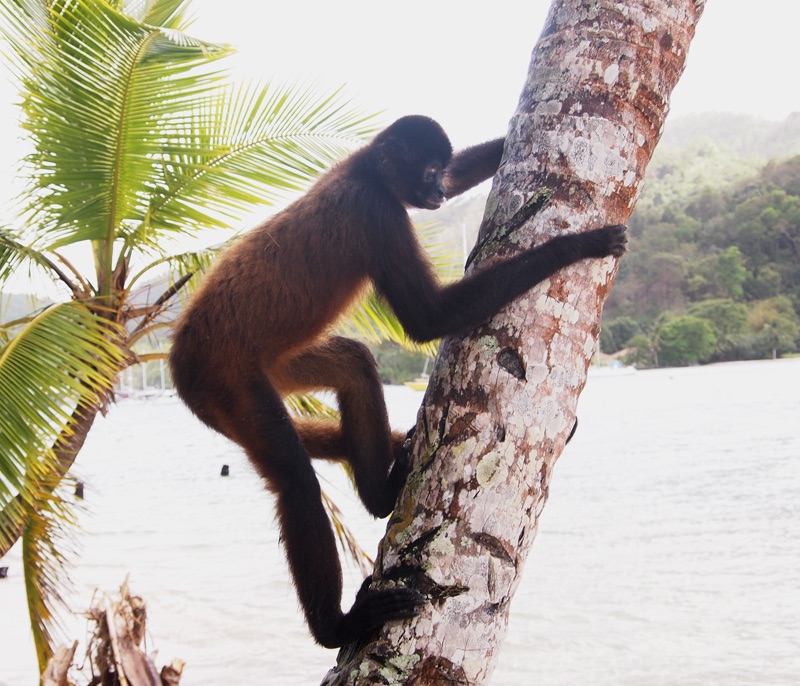

Isla Linton
Whilst at anchor here the weather continued unsettled, always strong winds, some heavy rain squalls and one knew the waves outside would be big.
by chris | Feb 2017 | UK to New Zealand
Before leaving Portobello I had completed and emailed in form 4405-i, the first step in registering your boat in the Panama canal system and requesting a transit.
Initial enquiries about getting a new exhaust elbow in Panama seemed to suggest I might have to wait 2 weeks but I found a guy in America who made them in Stainless steel so I ordered one from him. It took a week, 3 days to get from Virginia to Panama City via New York then 4 days to get from Panama City the 70 k to Colon, where I collected it from the Post Office. That was quite an experience in itself, 3 different counters to visit and different forms to fill and sign for then the packet was given to the Customs official who spent most of time sitting dozing on a chair who opened it to check that its contents matched the description on the customs form.

new ss exhaust elbow
That same day I also visited Citibank to check that they had received my canal transit fees through wire transfer and completed the last bit of paperwork. On to the supermarket for more provisions, stocking up for the long haul. Back at the boat the new exhaust elbow fitted and the engine run up – all good to go.
Earlier in the week I had arranged for an admeasurer from the canal to come and measure the boat and had completed all the necessary forms to request a handline transit of the canal.
The final step was to phone up the scheduler for a transit slot. I was given Friday 17th Feb.
I will have to be at the Flats anchorage to pick up my transit advisor at 14.00 then shortly afterwards motor the 4 miles to the Gatun locks. After the 3 locks you moor up for the night in Gatun lake before resuming the rest of the transit the next morning.
With a date assigned I phoned Tito to hire the necessary lines – 4 x 150ft 7/8 to 1”lines and heavy duty fenders. Now to find 4 linehandlers. If the canal webcams are working you might spot me in the Gatun locks sometime after 16.00 Panama time (Thats 21.00 UK time)
by chris | Jan 2017 | UK to New Zealand
Eventually the winds eased so more favourable for making the passage eastwards. Weighing the anchor I passed out of the bay and took good care to keep clear of the unmarked Lavandra Reef. A long tack north out to sea then I could tack east. I think 15 knots is my favourite sailing breeze, light enough to set all plain sail, not too strong to kick up much of a sea but strong enough to make reasonable progress.
By early afternoon I was in the vicinity of Green Turtle bay so I put in here and anchored awhile. It was as I expected too rolly to stay but I could prepare a meal before weighing anchor early eve and set off for a night passage.
Another long tack northwards away from the coast before tacking east again. The trick I find is to be far enough offshore not to worry about inshore shoals and danger but not too far so you are playing with the big boys, the tankers and container ships. Dawn saw me within sight of Punta San Blas. I had planned on anchoring at Chichame Cays but on approach it looked a bit crowded so carried on. However aiming for the Eden Channel I got a bit of a scare when I got the islands confused, went off line and strayed over a shoal patch. Maybe I was to tired and dim witted after the night passage with no sleep . I headed back to Chichame, entered the lagoon it was busy but enough room and anchored, time for some rest.
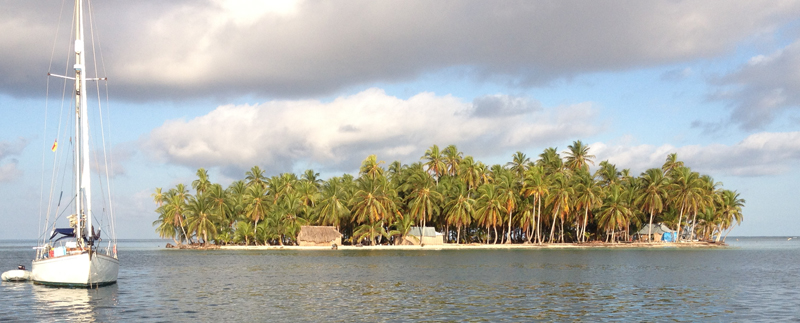
Beautiful though it was here, sandy palm treed islands, it was a bit like westerners doing their being on holiday thing. So next day I went in search of the real Guna Yala. I anchored off the island of Acuadup. Ashore was a traditional Guna village, palm leaf thatched huts, Guna indians in native dress, lots of dugout canoes. I bought some bread.

Moving on next day I passed through the well populated and busy Carti islands. I was put off anchoring here as you anchor in 17 m and have you ever tried pulling up min 3×17 m of 8mm chain and an anchor by hand? ( total wt about 85 kilos in case your wondering) Well I didn’t fancy it one bit.

one of Carti Islands
I went to Soledad Mira another traditional village and anchored. Unfortunately the holding here was not good, anchored on a small sloping boulder shelf, so left after a while and went to Los Grullos, anchoring off Kuandiup, just another sandy palm tree island. There was a Guna restaurant here so treated myself to a fish dinner.

Kuanidup

On to Mokame, a populated traditional island. Here I spent some time talking with a Guna guide who told me of some of their traditions, beliefs, and of the shaman and showed me around the village, the meeting hut or congresso, his hut and his Nuchus, small carved wooden statutes a link between the physical and spiritual side.
They live on the islands because they are free from insects and other things in the jungle on the main land but the tend gardens in the jungle for their produce paddling over there in their dugout canoes.
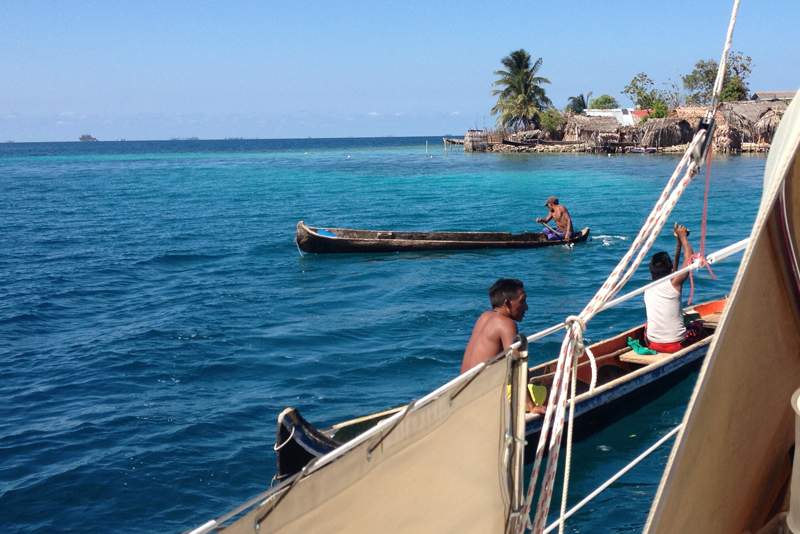

lobster man
Lobster for dinner bought from a free diver.
On then to Salardup an island in the Naguarandup Cays, a group of mostly uninhabited islands scattered along a 6 mile long barrier reef, further offshore than the inhabited islands. Salardup is in a lagoon approached through a gap in the surrounding reef. None of the reefs in the San Blas are marked, mark one eyeball navigation is required spotting the colour of the water to show you the depth.
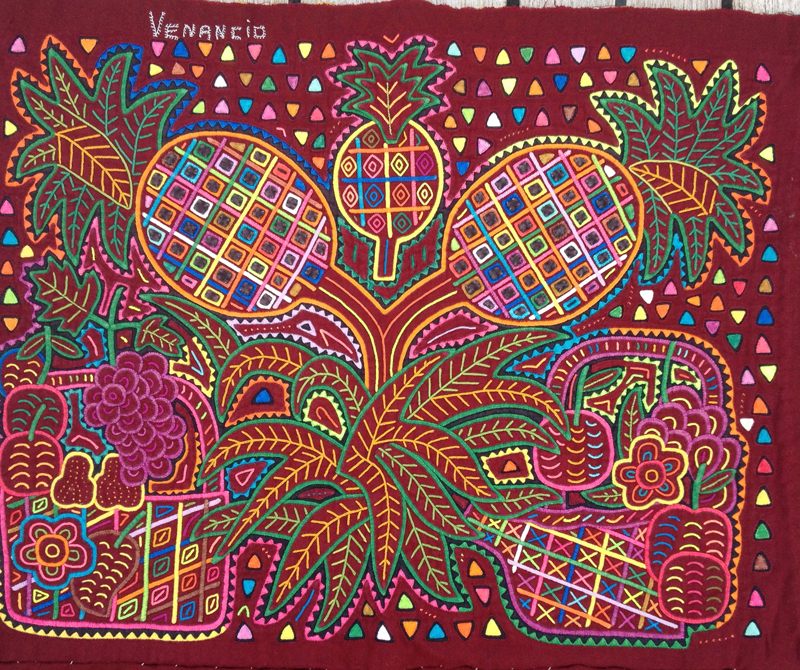
I completed a circumnavigation of sorts of the Naguarandup Cays, sailing down the inland channel then out past Kanlildup or Green Island towards the Coca Bandera Cays then back westwards to the Lemmon Cays to anchor between three islands with a very shallow approach. A long days sailing through beautiful islands, so many islands.
by chris | Feb 2017 | UK to New Zealand
I left Lemmon Cays soon after first light, as soon as the light was good enough to see the reefs. Out past the reefs and breaking surf I could set a course to clear the reefs of Porvener. A close reach this wind about 20 knots and a reasonably lively sea. I chose to get enough northing in to clear all offshore dangers meaning I could run down my westing free in that knowledge, rather like the old time clippers used to do. Once out at 9 degrees 38 minutes I turned westwards, putting Sea Bear on a beam reach and she fairly romped along. Much later the average speed on the log was showing 6.1 knots, good going indeed for us.
Rounding Isla Tamba and Isla Grande we were in good time and so instead of going in to Isla Linton to anchor I carried on to Portobello. The wind had eased a little over the last hour but rounding Drake Island and within sight of the anchorage with the log showing 60 miles covered in 10 hours, it died completely. No problem I thought I’ll just motor the last mile to anchor, but problem there was. The engine did not start, it would not even turn over but was locked solid. An initial assessment showed me that it wasn’t something I could fix right then. With wind I could have sailed in but there was none. I called up some cruisers in the bay over the vhf and explained my position so they said they would come out in their dinghies and assist. Before they arrived though a little breeze came back so I sailed towards the anchorage, the dinghies dully arrived and shepherded me to anchor. I was grateful for their support.
Safely at anchor it was out with the tools, out with the injectors, off with the exhaust elbow and drain all the seawater out of the engine and crank by hand to blow the remains out. Put it all back together and mercifully the engine started and ran. I warmed it up to drive out any moisture lingering. Finished well after dark and then I could make a cuppa and cook dinner. Puzzling over why this had happened I investigated further and discover the air inlet pipe to the anti-syphon valve was blocked, allowing sea water to syphon in to the exhaust manifold and thence the engine, Easily solved that but worse was that the exhaust elbow was corroded inside – only cure for that a new one.
Spent a couple of day at Portobello then headed off to Shelter Bay, turned out to be a very windy day and approaching the breakwater rain squalls too. Dodging both and outgoing and ingoing big ships I entered the breakwater and so to moor alongside in Shelter Bay marina. Time to try and get a new exhaust elbow and start with the canal paperwork.
by chris | Feb 2017 | UK to New Zealand
A few days before my own scheduled transit I went through the canal as a line handler on Philip’s boat Wandering Star, a 45’ Irwin ketch. The other line handlers were an English couple from Morpheus, my neighbours on the pontoon and a young Panamanian Carlos. Late afternoon and we picked up the transit advisor at the Flats anchorage and motored to the Gatun locks. Before entering we rafted up with a catamaran in the centre us to starboard and a big pilot house ketch to port. The Panamain canal line handlers ashore threw us hauling lines weighted with monkeys fists, we attached the mooring warps to them, we were walked into the lock and once in place the linehandlers ashore dropped the loops over bollards and the linehandlers on the boats took up the slack. Lock doors closed and water flooded in, the turbulence was considerable, there was a lot of strain on the lines and taking in the lines as the raft rose was hard. There are 3 Gatun locks and we passed from one to the other with the linehandlers ashore casting us off and walking us through to the next lock. Going through at the same time was a big freighter in front of us, they have only a few feet clearance either side so move very slowly, guided by the mules( electric trains) to which they are tied so it all took some time. By the time we were through the 3rd lock and could de-raft it had already been dark for some time and we motored to anchor near the designated mooring bouy to spend the night in Gatun Lake. Our transit advisor left us and we could settle down to eat and drink a few beers.
Resuming the transit the next morning with a new advisor, we motored across the lake then through the cuts past Gamboa and through the Gaillard cut, past Gold hill, under the Centenario bridge and so to the San Pedro lock where the descent to the Pacific begins. Rafting up again we entered the lock , this time in front of a freighter. Down-locking is much more gentle with no turbulence. On through the Minaflores lake to the 2 Minaflores locks and then finally to the Pacific. Just a few more miles and under the Bridge of the Americas and there is Balboa Yacht Club with its moorings. The club boatman ran us ashore and we said our farewells to Philip and taxied back to Shelter Bay. It was a worthwhile experience and had prepared me for my own transit.
For my transit I enlisted the English crew of Tintin, recently arrived and scheduled to transit a few days later. Motoring out of the marina Sea Bear felt heavy and sluggish with 5 aboard. At the flats waiting for the advisor I talked through the procedure with the crew and when the advisor arrived we set off for the locks.
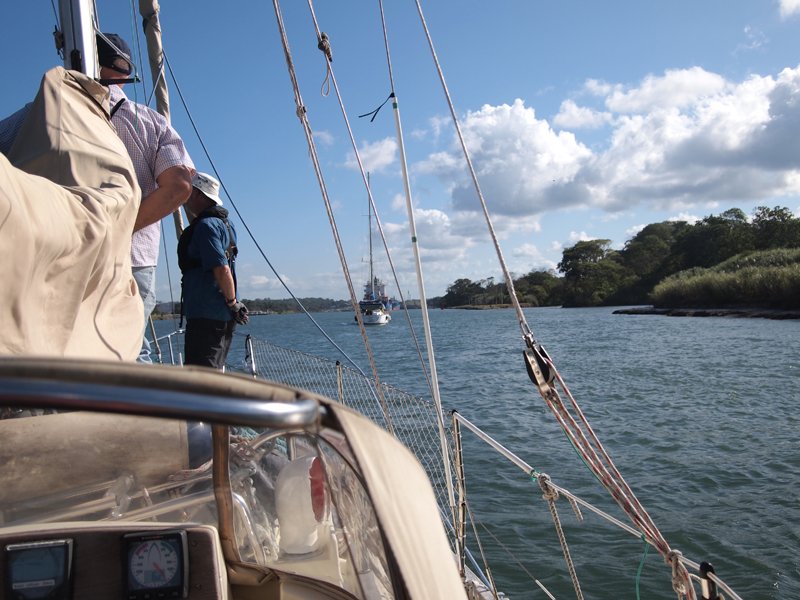
Approaching Gatun locks
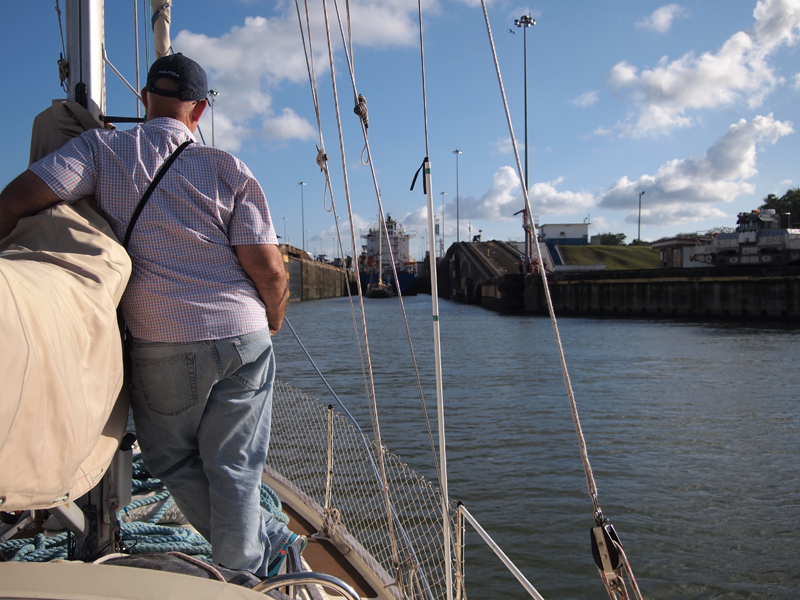
Entering Gatun Locks

In Gatun locks
Sea Bear was rafted alongside 2 big yachts and the advisors said the 2 big yachts would do all the line handling and manoeuvring. We were just grateful passengers and so had an easy time of it. Passing through the Gatun locks was quicker this time so we were moored up to the big buoy before dark. Dinner was cooked and eaten and some beers drunk. Now Sea Bear has only 3 bunks so I slept in the cockpit and another elected to sleep on the foredeck It was a fine night.

Mooring buoy Gatun Lake
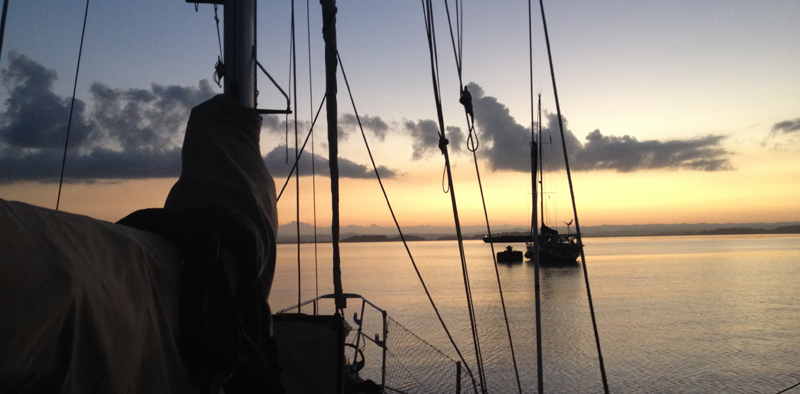
Sunrise Gatun Lake
The advisor had warned that they would be early next morning and indeed Larry, our new advisor turned up at 6.45 and we were off. Tea was already brewed so I let one of the crew helm whilst I cooked breakfast for all.
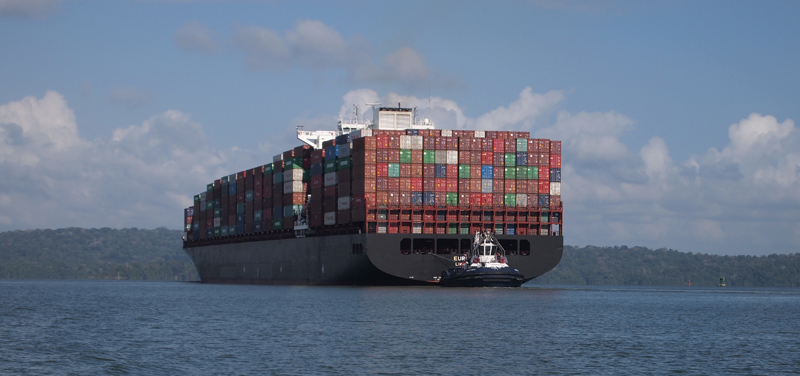
Panamax on Gatun Lake
When doing your transit application you must specify your cruising speed, I had specified 5 knots, this is the minimum speed allowed. I was little concerned at being able to maintain this especially so heavily laden as we were but we averaged 5.7 for the next 5 hours that we took to motor the 28.6 mies across the lake and to the San Pedro lock, where we arrived at 11.45. The lake is quite beautiful with lots of tree covered islands, on the biggest of which is the Smithsonian Tropical research station. We did this time see a crocodile basking in the shallow of one island.
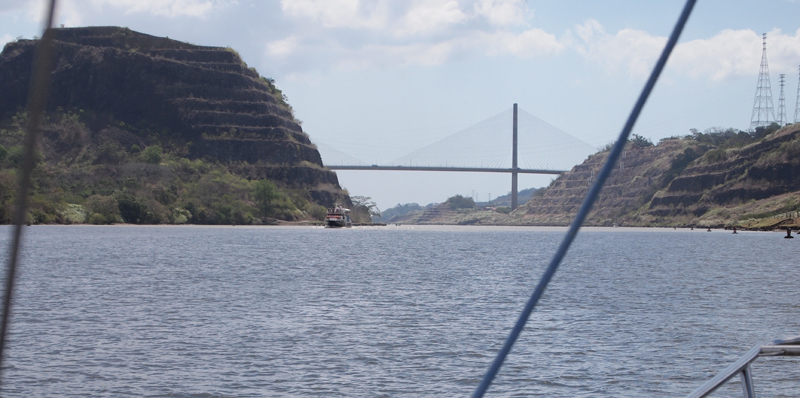
Gaillard cut, Gold hill & Bridge Centanario
Down-locking this time was quite quick, no big freighter to wait for, rafted together again with Arielle, and a French Onvi, we locked through with a big sail training ship and a passenger ferry.

San Pedro Lock
Exiting the San Pedro lock we spotted another crocodile. Shortly after 2pm our advisor was picked up and we moored to a mooring buoy at Balboa Yacht club. It had been and easy and stress free transit.

Bridge of the Americas
I went ashore in the club boat with my crew and dropped of the tyre fenders (3$ each to hire 1$ each to drop off). The crew of Arielle were at the yacht club and we drank some beer before they went off in the taxi that we had pre-arranged back to Shelter Bay.
Connected up to wifi I discovered that John Whittle, an old friend and work associate from my time as a climbing guide had suddenly died. So no joy at being through to the Pacific. The day ended on a sombre note and I drank the last of my beer in remembrance of him.