by chris | Mar 2016 | UK to New Zealand
If you wanted one word to describe the Dominican Republic it would be loud!. Music is played everywhere at full volume, even little general shops have a speaker the size of a fridge balanced on the counter cranked up to full volume. Its a lively place to be sure here, a beach to one side of the marina with lots of wooden shacks In town the other way its a crazy place, music , teaching salsa dancing in the courtyard of a hairdressing saloon, a couple dancing on the shop floor of an off-licence, bars with people outside filling the pavement.
Music here is more latin american – sort of salsa music and the buildings too very different from the rest of the Caribbean islands .

Dominican art
I went into Santa Domingo by bus. It is a very big bustling city and felt a little overwhelming specially when I got of the bus and had no clue whereabouts in the city I was. I got my bearings after a bit and wandered around the old colonial district. Its like another place altogether, very quiet and peaceful tidy and clean, some lovely buildings and streets, found the statue to Christopher Columbus. The rest of the city is mad by contrast, traffic with no rules street sellers street stalls noisy and busy and chaotic.
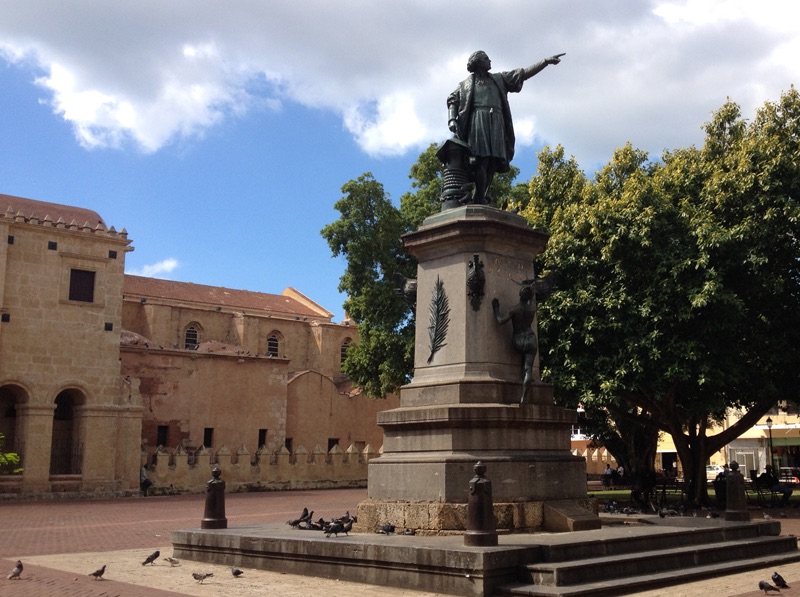
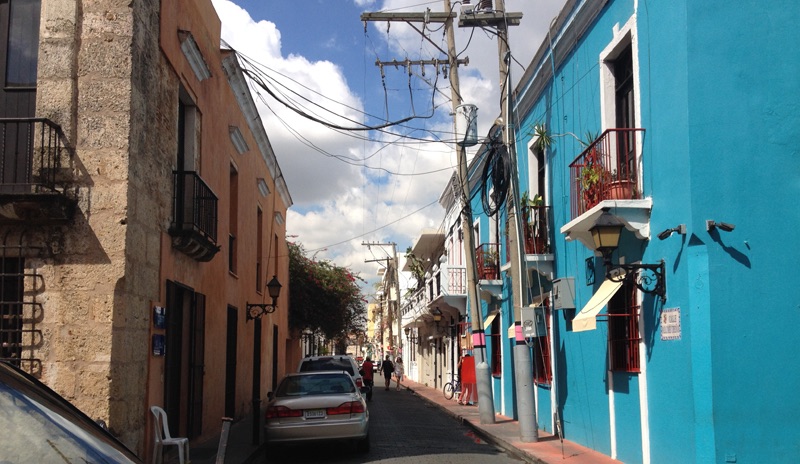
Had some lovely pineapple – the fruit and veg here is about the best I have seen in the Caribbean and the cheapest.
I was ready to leave Boac Chica but the weather forecast was for very strong winds 35 -40 knots at the next cape and at Capo Beata around which I have to pass so stayed.
I spent an eve sitting on a crate on the pavement outside a store drinking cheap rose wine from an ice filled plastic cup with the manager from the marina. He asked me if I wanted to join him and visit his home, said he would meet me outside the office at 6 but if I wasn’t there he understand that I didn’t want to go. Well of course I wanted to go and he was pleased when I turned up and he took me on the back of his little motorbike to his house and then through some streets and alley to the store where he bought the wine and we sat and talked. His house was down some mud yard and the back yard was all earth and rocks with some assorted bits and pieces around and the living space tiny. I am sure it would horrify most westerners how they live. He said that they live like rabbits, the street are pretty crowded, most life is lived outside it seems, cheek by jowl as it were. He seem to be at work from 8 till 6 and only gets 1 day off a week, it must be a pretty tough life. Later he ran me back on his bike, getting dark, no lights, no crash hats of course and in flip flops. The roads are potholed and with open drains across them and no traffic rules it seems.
Felt a bit privileged to get some insight into life here.
Eventually the winds eased a little and after receiving my dispatchio I made an overnight passage to Salinas.

leaving Boca Chica through the reefs
A lovely bay where they have extensive salt pans to get sea salt.
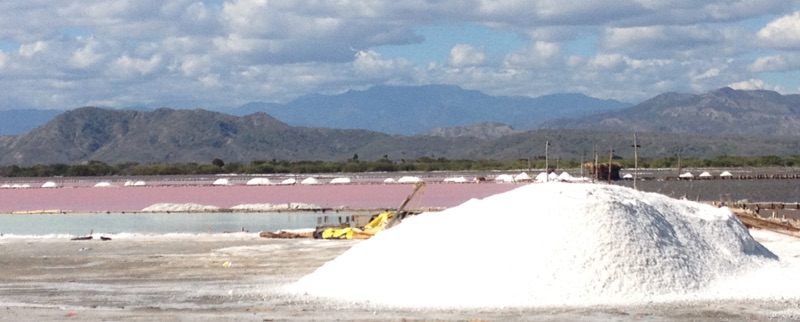
salt pans
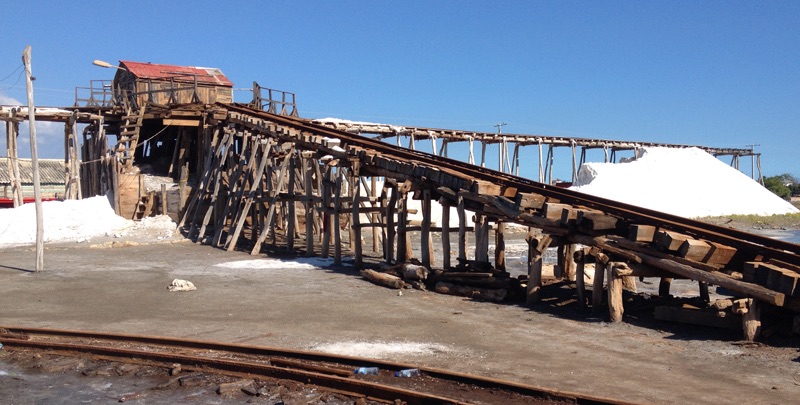
Shortly after I arrived had 30 knots of wind and suffered a dragging anchor, the holding wasn’t so good so had an anxious and unpleasant time for a while. After a day or so I moved just around the corner as it were to Palmars de Ocoa, just another lovely beach with a little fishing town backed by mountains.
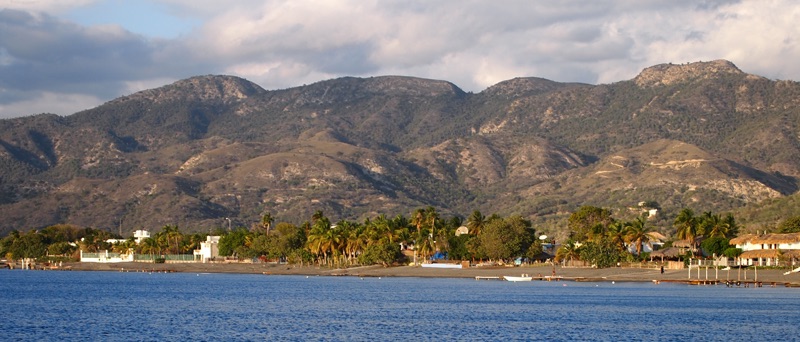
Palmar de Ocoa
On then across the bay to Santa Cruz de Barahona, quite a busy town, a sheltered anchorage but not so scenic. I had thought I might stay here, perhaps visit the mountains and a big lake inland where they have crocodiles but the only place to leave a dinghy seemed to be a rough concrete wharf and there was a bad surge so decided to move on. Perhaps I was getting fed up of DR, to go from port to port you need a dispathcio from the coast guard and although official they should be free once you have paid your entrance fee for the boat, the officials ask for 20$, a bribe basically. Here they made a bit of a fuss but I just stonewalled them, said I had no dollars and eventually although they were not happy they gave me a dispatchio and exit stamped my passport.
I left at first light and sailed down the coast for about 40 miles to Capo Beata, I judged that if I rounded the cape it would be dark so I gybed and took the passage Canal de Beata between the Ilas Beata and the mainland. As soon as I gybed the boat accelerated, there must be quite a current running through here and the swell which had been troubling me all day disappeared and the depth dropped to around 4.5 to 5 metres. It was dark before I passed Cabo Falso so I could not stop at the Bay of Eagles, which would have been my last anchorage in DR, instead I carried on another 150 miles past the coast of Haiti towards Il a’ Vache.
by chris | Mar 2016 | UK to New Zealand
During my second night at sea I estimated that I would arrive at Il a’ Vache whilst it was still dark so I reduced sail to slow down but at 4am after I had spotted the light on Il a’ Vache still some 8 miles away I hove to for a while so I would not arrive before the dawn.
Later turning north to run up between the island and the mainland I caught sight of the first of many of the traditional sailing fishing boats of the area and a bit later the first of the dugout canoes that they still use.
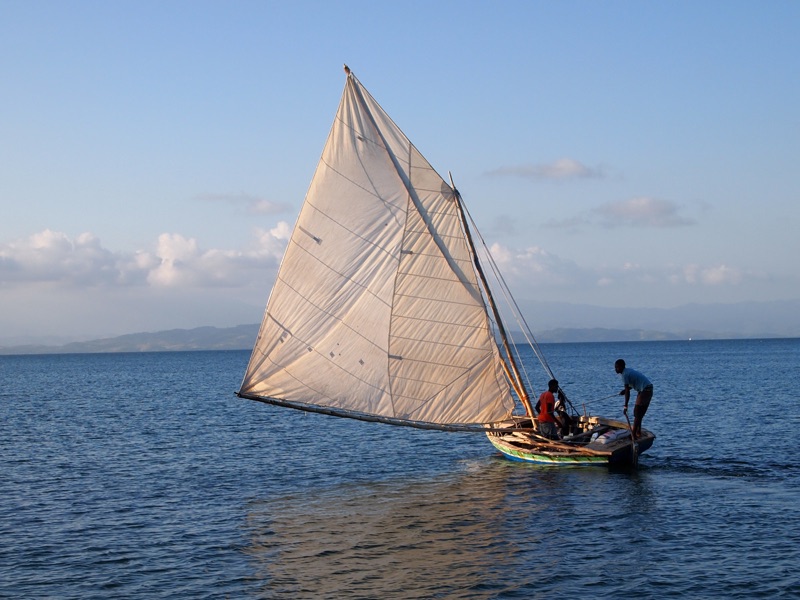
Turning in to Baie Feret I had a welcoming committee of boat boys in dugout canoes all offering their services for this and that, a bit distracting when all you want is to find a spot to anchor. Safely anchored and the boat snugged down, sail covers on I pursued then to leave me alone for a bit because I need to sleep a bit.
Here already at anchor where the young Norwegians in their boat and Rene (French) and Rod (SA) who had left Boca Chica a few days before me. Hearing their tales made me glad that I had waited for the strong winds to pass. The Norwegians had suffered a knock down with their mast in the water in big rough seas, smashing their autopilot and solar panel, and bending the pushpit and some stanchions whilst the French boat had suffered damage to a sail, their gooseneck fitting and had lost a dinghy.

Il a’ Vache is a beautiful place, around the shores of the bay is a simple village Cai Coch, no electricity (although now they do have a few solar powered lights), no running water. There are no roads, no cars, some little motorbikes only. The people walk mostly sometimes ride horses to get about and live by plot farming and fishing from wooden sailing boats or dugout canoes.
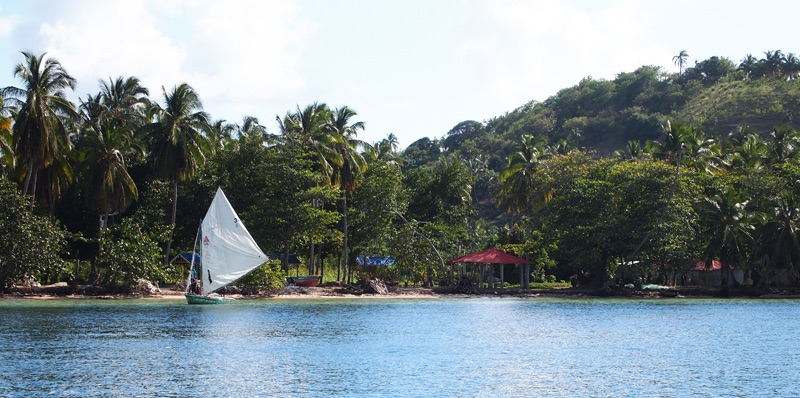
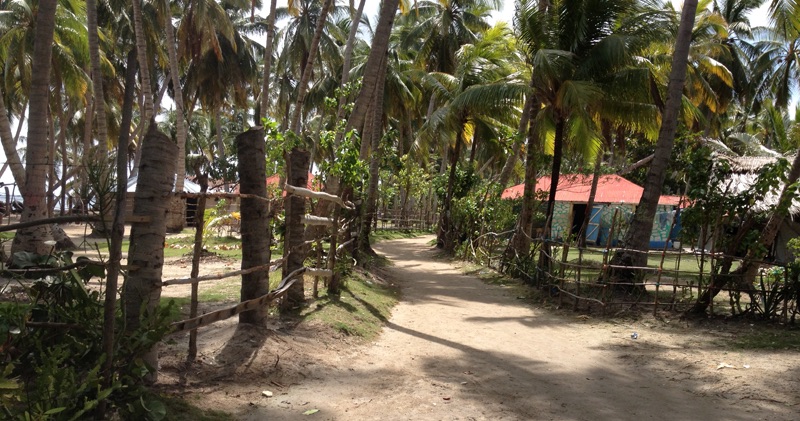
I walked over to the market at the village of Madame Bertram, pigs, goats, chickens, fish, vegetables, soap, rice all for sale spread out in chaotic fashion on rickety stalls amongst the mud and the garbage with sailing boats that have bought in the goods in the bay and women arriving with a basket of sweet potatoes or coconuts or breadfruit balanced on their heads to sell. No pictures I am afraid as they get a little touchy about having pictures taken but it’s a scene that could have been hundreds of years ago.
by chris | Mar 2016 | UK to New Zealand
After a few more days at Ile a’ Vache it was time to move on once more, so after a quick trip ashore to buy bread I made ready to sail and finally bid goodbye to Marc and Jeff the boys who had been my almost constant companions these past few days.
Out of the bay I hoisted sail and ran out down the wide channel between the mainland and the island. Rounding Point l’ Abacou I could set my course to run parallel to the coast and with 2 reefs in the main and staysail set progress with the strongish winds quite rapid and the swell not too troubling. There certainly are some big mountains in Haiti so the scenery was quite spectacular. The wind was not too last though and shortly after sunset it was dropping so contrary to my usual practise I had no reefs in this night instead had all plain sail set and progress was slow. At least I had a full bright moon. I could alter course more northwards now for Cuba, aiming to clear the extensive shoals that extend westwards from Cap Tiburn. A sudden wind increase at 3 in the morning shook me from my torpor and I put the first reef in the main followed shortly by the 2nd. Of course no sooner than the 2nd reef went in the wind dropped again, ah well.
Dawn revealed Navassa Island well off to port. It remained in sight for hours as I drifted and sailed in very light winds and near calms all morning. Eventually however we got a little wind and so it continued throughout our 2nd night with a little short lived rain squall to liven things up.
Dawn revealed just empty seas all around just some cloud to the north. Mid morning and the mountains of Cuba could be seen but as the day wore on the wind dropped again. An assessment of the situation mid afternoon was that at present speed (about 1.5- 2 knots) I would not arrive
before dark and not fancying entering a strange port at night it was on with the engine. So it was that I entered the channel leading to Santiago de Cuba and anchored off the marina at Punta Gorda just before sunset.
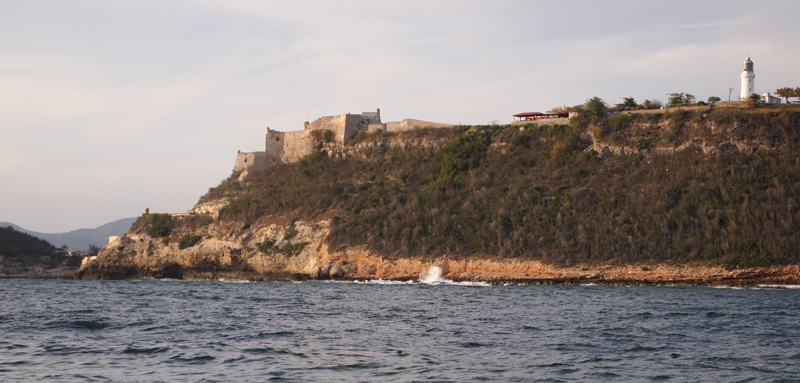
Castillo del Morro, approach to Santiago
In the morning I dinghied to the dock to pick up the doctor and took her back to the boat. She asked me a few questions and took my temperature and pronounced me free from any “lergies” . They take their health seriously and want to keep Cuba healthy. Then I visited the coast guard and answered their questions, no forms to fill in, all on computer these days. They then inspected the boat, content with letting their sniffer dog , a cute little docile spaniel, have a good snuffle around. Then clearance and visa issued and I was in Cuba.
First thing was to get some money. I was offered a lift into Santiago, about 10 miles by a German who had a car. This was too good an opportunity to miss so I hurriedly grabbed a few things from the boat and into Santiago I went. Kurt dropped me at the Hotel de Santiago. Here I got some convertable pesos and then had a wander around, getting a bit lost but not too badly. It is a big sprawling city but first impression very clean, none of the litter and garbage strewn about that you see in Domincan Republic. Old american cars a plenty, MZ motorbikes which brought back memories of my time as a motorcycle mechanic, horse drawn carts, big trucks which acted as buses. I bought a few veg at a farmers market and eventually took a taxi back.
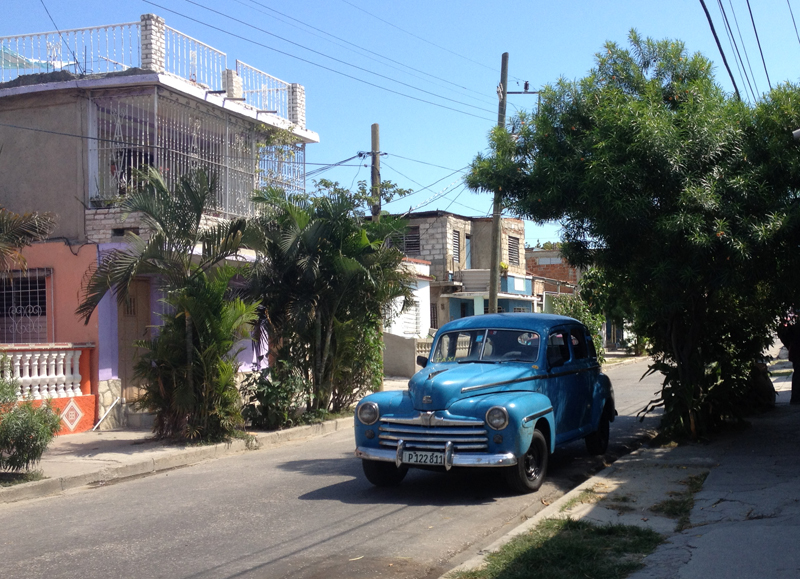
Car & street Santiago
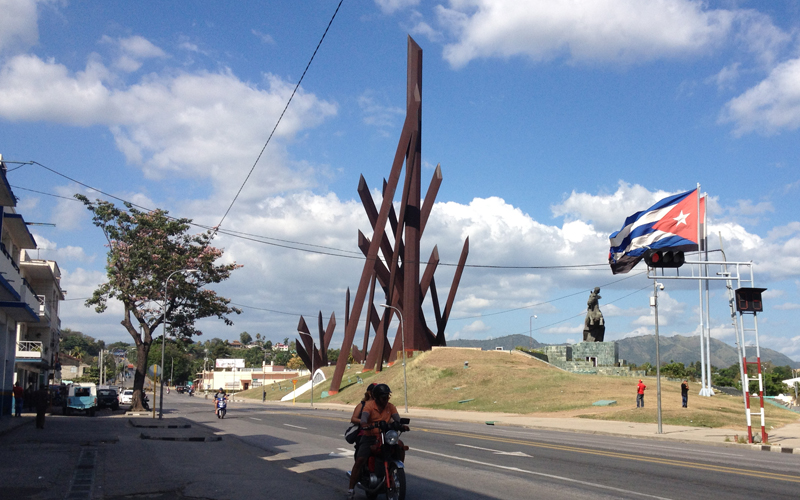
Plaza Revolution
by chris | Apr 2016 | UK to New Zealand
I spent a few days anchored at Punta Gorda, took a ferry into Santiago a few times to wander around ,see the sights and listen to the music. i also cycled out to Castilla del Morro and called in at a little beach for a swim. I also went for a walk to a prominant limestone bluff inland by tiny paths through the bush and on top buzzards soaring just feet above my head. The Norwegians lads, Olaf and Knut had arrived too, but they are off eastwards and northwards. I am still westward bound. I was ready to leave but strong northerly winds were forecast for Cabo Cruz so I delayed a day or two before leaving. Next stop down the coast was Chivorico, a tight entry between the reefs into a lovely little lagoon. On again to Marea del Portillo and easier entry into a big lagoon this. My first eve there and the 30+ knot northerly arrived as dark fell, the anchor dragged so I put out the Bruce as a second anchor. In the midst of this the Guarda arrived in a little rowing fishing boat, they were having quite a struggle in the wind and I was surprised to see them on on a night like this. Ashore was a little fishing village, this was rural untouched Cuba, lovely. I got some peppers tomatoes and cucumbers from a plot farmer,he wanted some fishhooks so I gave him some.
A short hop took me to Ensenada Tiburcio, I didn’t like this entry, it started off easily enough well marked with bouys but thereafter it was unmarked between a shoaling shore and unmarked reefs.
The anchorage at Cabo Cruz is reached around a long breaking reef but at least well marked and is some way from the town and the lighthouse.
Ashore I met with a lovely Dutch couple of “Bandos”. We had seen each others boats in various place but never meet before.
The next stretch was the Gulf of Guacanayabo and Gulf of Anna Maria and the Jardines de la Reina. This is a labyrinth of hundreds of uninhabited cays, reefs and shoals. There are just a few fishermen but otherwise I would be on my own, few cruisers come this way, it is wilderness unspoilt. The pilot guide recommends a good bow watch to look out for shoals and coral, being on my own meant I would have to do without, this led to a degree of apprehension about this stage.
To the next anchorage was too far to make in daylight so I left just before dark aiming to arrive at the entrance to the Canal de Cabenza del Este, which leads into the inshore passage behind the reefs by daylight. Here I would enter into the gulf of Guacanayabo.
It turned out to be a wild night, the wind got up and barely dropped below 30 knots all night, I was down to the third reef in the main and a reef in the staysail and of course I arrived at my waypoint for the canal whist still dark so decided to hove to for a while till dawn. With the wind out of the NE it was quite a battle to head NE through the canal, bashing into a nasty short chop and finally to Cayo Granada to drop the hook.
The following days I transited the Canal de Rancho Vieja and Canal del Pingue leading into the gulf of Anna Maria. The word canal gives the wrong impression, there are no banks as such you are sailing through what looks like open waters with the occasional reef and cay visible and some marker posts to guide you, but stray of track and you will be aground on the shoals! A series of anchorages at Cayo Chocolate, Cayo Manual Gomez, Cayo Ingles, where I passed to the outside again then Cayo Breton , Cayo Macho de Afuera and finally arriving at Casilda. It had been a very intense experience, the peace, the silence were outstanding at times but it had been hard work, concentration needed at all times.

music in the plaza

Cabo Cruz


by chris | May 2016 | UK to New Zealand
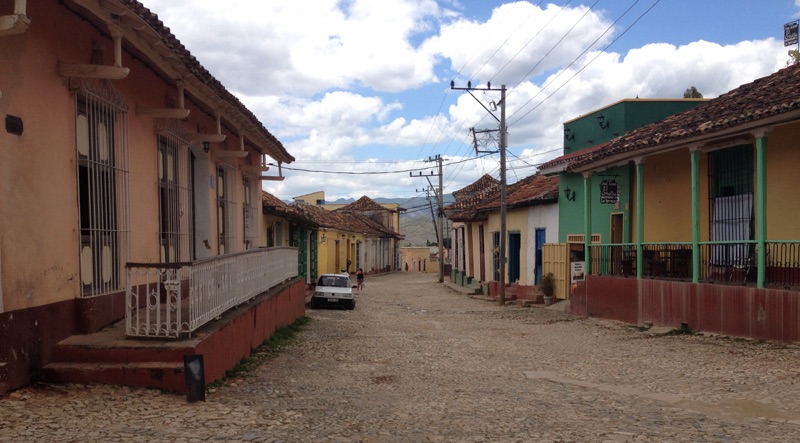
Casilda is the nearest port to the town of Trinidad, this is a lovely historic city, one of the oldest in the New World founded in 1514 and is one of UNESCO’s World Heritage sites. Well worth a visit and I spent a couple of days wandering around its cobbled streets.
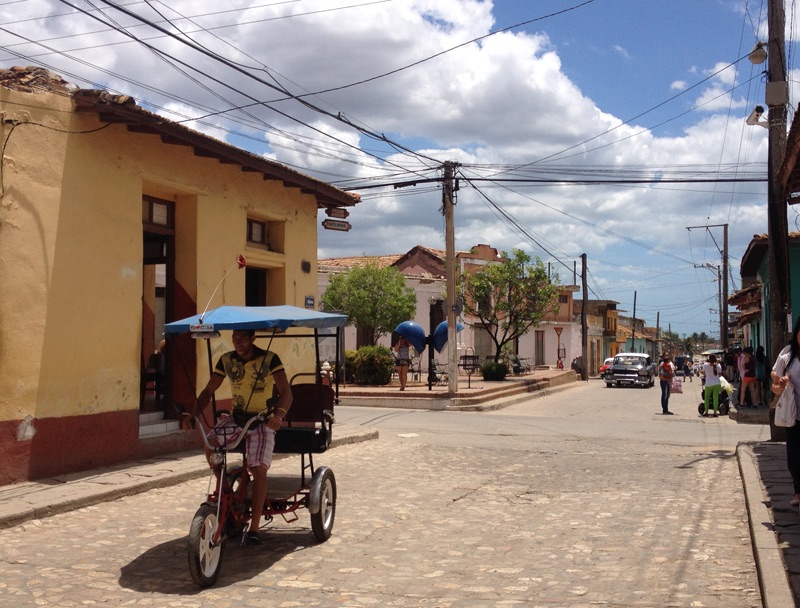
streets of Trinidad
On then to Cienfeugos about 35 miles down the coast. Here there is a fairly narrow entrance to a big enclosed bay and you anchor off the marina. A walk down the Malecon takes you into the busy city. There are some fine old colonial buildings and a nice plaza and I soon discovered my favorite bar where you could sit outside in the shade under a colonnade, drink beer and watch the world go by.
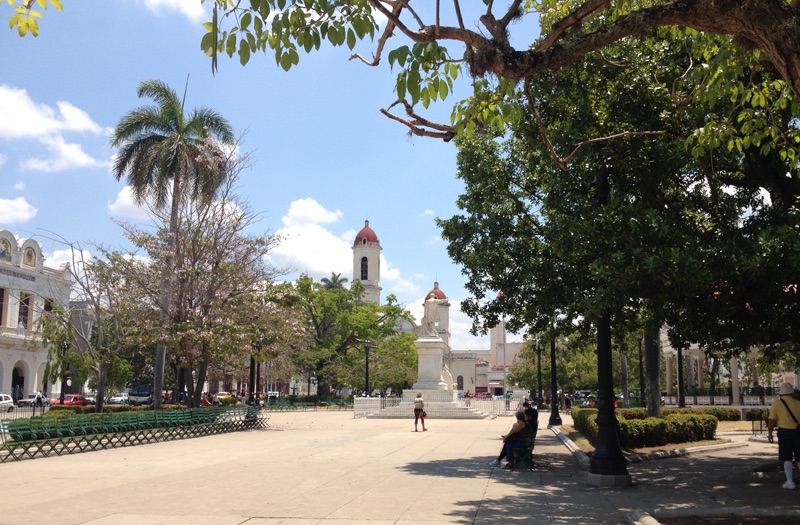
Ceinfuegos

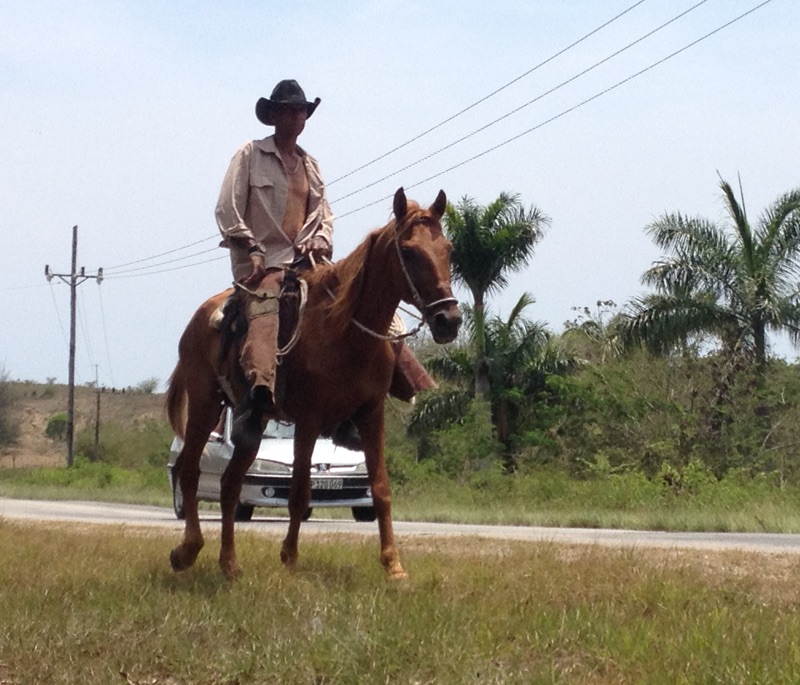
One day I took the bike and headed out into the country past vast orchards of mangos then just wild country side. After about 16 miles I ended up at Playa Blanca, a nice little beach so swam before heading back. Saw a real vaquero, complete with leather chaps and lariat as well as lots of horse drawn traps and of course old american cars.
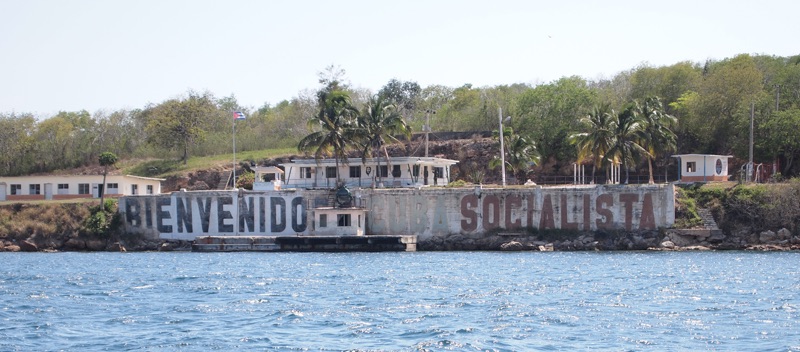
All too soon my time was up , my Cuban visa had run out so although I could have renewed it, time to leave and move on. next stop the Cayman Islands
by chris | May 2016 | UK to New Zealand
Of Caves and Dragons
I left Cienfeugos a little later in the day than I hoped, put it down to bureaucracy, settling my anchorage bill with the marina and then getting a dispatchio from the authorities. They visit your boat before issuing you that and exit stamps on your passport for a quick search, probably to check you have no Cubans aboard. So it was about 2.30 before I weighed anchor by which time the wind had switched to the south so a head wind for leaving, fortunately not too strong. Outside the bay progress was slow, I couldn’t lay the course I wanted, away from the coast took me SSW and I certainly didnt want any westing in my course, the other had me gradually closing the coast which trends NW-SE here. The other big danger to avoid was the Banco de Jagua lying some 25 miles offshore, unmarked with dangerous seas and numerous wrecks. The wind shifted to a more easterly direction after sunset but then fell in strength till we had barely a light breeze. Eventually though I was clear of all dangers, just empty seas between me and the Caymans.
In the early hours we had some wind back but by midday almost a flat calm. I even resorted to motoring for a while. That night was weird there was lots of phosphorecence and the sea so flat and glassy that the stars were reflected in it. I was dozing below when the wind returned, at last we could make progress. I spotted the island, a low smudge on the horizon just before noon and later in the afternoon picked up a mooring at Scott’s Anchorage, Cayman Brac.
The authorities came to meet me on the dock and were going to come out to the boat to complete formalities but looking at the size of my dinghy decided to do it ashore. I just had to ferry the mosquito control officer out to spray the inside of the boat.
Ashore later I had Cayman Island style shrimp for dinner and a few beers. I was in a bit of culture shock, there was a supermarket with everything you could wish for for sale, after months of very basic stores and not being able to get things this was wonderful and of course English was the language, no more struggling to get by in spanish or french as I had for months.
Both the islands are small, about 9 mille long by 2 wide, about 1,500 people live on Cayman Brac whilst on Little Cayman the resident population is about 150, the people are very friendly.
Exploring Cayman Brac I was offered a lift and was taken along the the Bat cave, fascinating but saw no bats. Walking back I visited Rebecca’s cave then hiked across the salt pond trail back to the North side of the island, hard going this across tortured sharp eroded limestone, in flip flops too.

Track across Cayman Brac
Next day I sailed across to Little Cayman, I though to take a mooring in Spot Bay but discovered the dock there, old and concrete too high to land on from a dinghy. I moved on around to Owens Sound, entered through a very narrow gap in the reef with breaking waves either side, scary and once inside calm but very shallow, around 2 metres with shoal patches. Pleased to be in and secured to a stout mooring bouy.
Little Cayman is famous for its iguanas, a number live around and under the old museum so that was my first stop . What wonderful beasts they are iguanas everywhere I looked, stopping at a respectful distance one big one about 4 ft long eyed me up and then came across, stopping about 2 ft short of me.
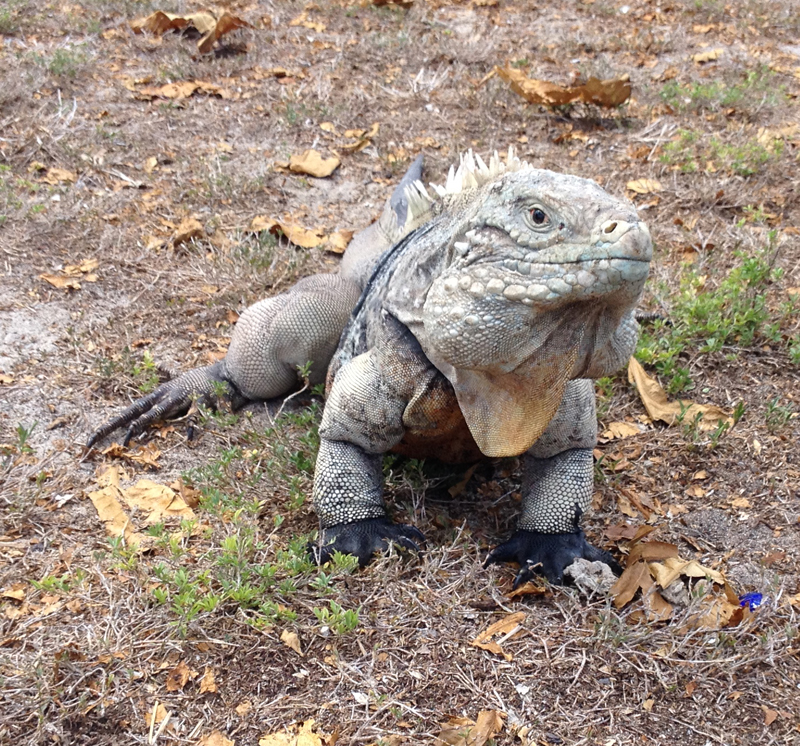
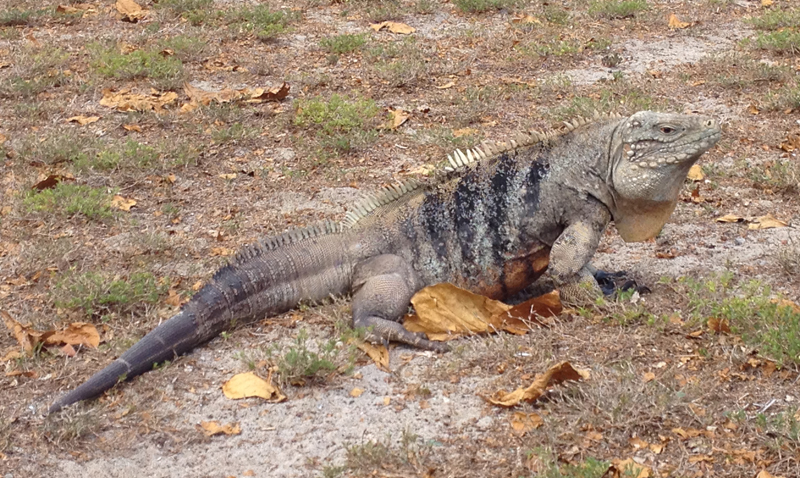

I rode my bike around the island, about 20 miles but it felt longer, traffic count 2 cars 4 iguanas. Stopping of at Sandy point the SE tip was a beautiful white sandy beach with azure sea protected by a fringing reef. Had the place to myself had a lovely swim.

Sandy Point Little Cayman
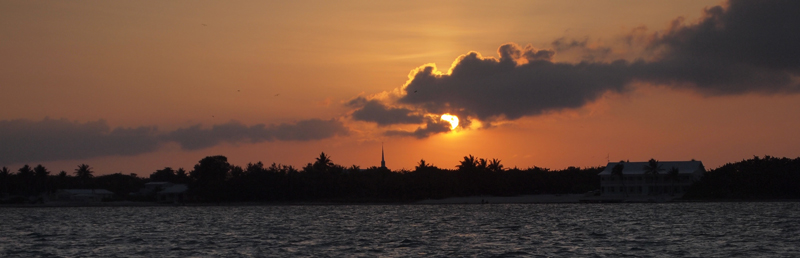
Sunset Owen’s Sound
It blew hard in the early morning with torrential rain, had a bit of a fright when I thought the mooring might be dragging so found myself stark naked in the rain and dark putting out the anchor, washed the salt off I suppose. Turned out it was just the long scope on the moooring.
Leaving through the reef was worrying with a swell running in from the south after the blow, just line up the range markers astern, aim for the middle of the small gap between marker post and buoy and then for that gap in the breakers outside, safely out phew!
Back on Cayman Brac I cycled and walked up the coast to the Brac, a big limestone cliff, home of many caves and walked up the lighthouse steps to Peter’s cave, used as a hurricane shelter by the locals.

Peter’s Cave
The other way I hiked part of the trail through the parrot reserve, didn’t see any parrots though.
I could have stayed longer on these delightful peaceful islands but if I wanted to visit Jamaica before heading out of the hurricane zone. It was time to move on.